Sunday, 29 July 2012

Hidden Well-th

Visiting the sights of Istanbul, you would never guess that under the hill on which you walk is a cistern, a man-made cavern capable of holding 80,000 cubic metres of water. A cistern built 1500 years ago to provide fresh water to the Great Palace of Constantinople on First Hill. Stumbling down the narrow stairs, it's hard to imagine what to expect at the bottom for there's no grand entrance befitting of this engineering feat. As you reach the bottom of the flight, a seemingly endless cave opens up before your eyes. Illuminated in warm red lights, the classical grid of columns disappear into ambiguous light then inky darkness. As you wander between them, mirrored avenues open up, before blurring as the waters beneath your feet vibrate with life blurring the symmetry of the decreasing arches.

The surge of ravenous fish remind you of the stories of locals above catching fish in their backyard wells, wells which possibly penetrated the structure of the waterproofed roof and re-discovered a forgotten marvel. In one corner, two versions of Medusa's head support the roof. They lie at angles, sideways and upside-down, supposedly to negate the power of the Gorgon's stare though this is the first I've heard of it. 
The dim red light there produces a kind of eerie romanticism, but don't look too closely for the red light hides the film of green algae that accentuates the features of Medusa and brings into contrast the patterns of the 'peacock-eyed' column.


Tuesday, 24 July 2012

The meaning of life...

For the last month of my time in London I worked for a company who's offices were just off Oxford St, my window overlooking an intersection and the entrance of one of London's biggest stores. Despite being on Oxford St and tolerating the shopping rush every afternoon as I fought my way towards Bond St Station, I enjoyed the location.

In the morning the street was wide and deserted, the only people present were workers like me, rushing to get to their computer screens in buildings overlooking the length and breadth of this infamous shopping strip, or shop assistants who landed the early shift and have to open in time for the inevitable onslaught of customers.
By lunchtime the crowds have arrived, but by then you were hungry so you'd become a woman on a mission. You knew the choice the area offered and so made a headlong dive for the nearest shop that will supply your stomach's desire today. With just a wallet in hand, it was easy to manoeuvre through the growing crowd and be out and back in minutes, allowing you to enjoy your hard earned lunch with the personal space your office desks provides.
The evenings were more dangerous though, for not only were you now juggling bags and coats and potentially umbrellas too, but your time was now your own and how you chose to spend it entirely between your conscience, your wallet and you. Oxford St is a dangerous street for it is the ultimate high street and if what the street doesn't stock, the departments stores thereupon are bound to stock.

However what made this particular office memorable was not its location, even when the Olympic torch passed beneath our very feet. Looking out of the third floor window perched within the glass projected corner of the office I recalled the imagery of the Permanent Assurance Company from Monty Python's Meaning of Life sailing through the big city as though the buildings had parted way for them alone. I don't recall why, but this singular imagery of the old Edwardian building, noble and silent in its purpose gliding down the deserted streets stuck with me throughout my month there and did something towards relieving any seriousness and drabness that can come with London office life. 

Saturday, 9 June 2012

With the death of Ra

On our last night in Cairo the small group of us climbed onto the roof of the hotel lobby to watch the sun set. Given our position on the west bank of the Nile on the outskirts of Giza we could see the silhouettes of the pyramids set against the glowing sky and stare in awe as the orange glow slipped over the horizon and faded into obscurity.


Staring as the sight, it wasn't difficult to place it in the context of history and take delight that for several millennia now people had watched as we'd just watched the sun complete its daily journey across the sky and slip over the western horizon. It was a natural occurrence  the earth travelling anti-clockwise signalling the end of the day, and the end of our holidays and return to normality. Just here, the scenery differed somewhat from the standard views we'd grown up with in the antipodes, the warm sun setting over the mass of Australia or over the Indian Ocean, its glimmering light offering the image of a stairway to heaven. It also differed dramatically from the cold greyness that many of us had become accustomed to living for so long in London.

As we currently stood, a group of youngsters enjoying the mid-term week off from our lives as teachers and professionals I did wonder how many of us were thinking about the stories we'd been told throughout the week: the division of the land into East and West, life and death along the undulating length of the river Nile. Where we stood now on the west bank looking towards the funeral monuments of the horizon, watching as the sun died a brilliant death, to be reborn behind us in the cool light of the tomorrow's dawn, it wasn't hard to see why the Pharaohs had chosen to be buried on the left bank. Why they had been so desirous of associating themselves with the sun, hoping and praying that like it's god Ra they too would be reborn as gods, continued in their worship by the populous below.

Thursday, 7 June 2012

The Exoticness of Standard Fare

The more time I spend in Egypt, the more I see that reminds me of my grandfather. He's not Egyptian, though the fact he was born in Alexandria confuses most people. And until the British were force-ably removed in 1952, he lived and work in Alexandria. He worked for a ship-chandler but in cohesion with  the natives (terminology from his day) enough that he wrote and spoke the language and partook of many of the meals that were typical of the roadside eateries of the area. Still, 50 years along, I hear stories of meals they ate, learn first hand how to make delicacies, the ingredients of which are only now becoming available in our spice markets and foreign grocery stores. Dishes like Ful Mesdames have become a standard part of my diet, a quick and refreshing meal to make on a lazy evening when takeaway just won't cut it.


It is a strange feeling as I feel I should be exhibiting feelings of interest or excitement at trying something new and exotic, and yet more and more I find I it to be something I know from my own unexciting, perfectly standard childhood. For me, the delight of watching baba-ghanoush being made before my eyes was missing: here is not an exotic dish that was only ever found in the aisles of the supermarket, but one I've seen before, I've made before, one even the most un-ethnic of my family have perfected the art of making.


And then to hear the standard fare of the local Egyptians when meat is short or unavailable, the strangest and most unusual (un-western may seem a more appropriate term if such a term exists) of the Egyptian dishes to which we were introduced. It's a dish I recognise, if more by taste, by name, by story, by my Mother's reaction: a gelatinous soup made for the leaves of a local plant of the name Molokhia.

Wednesday, 6 June 2012

Temple of Isis, Philae

06 June 2012

On the afternoon of our outing to Abu Simbel, we visited another temple rescued from the depths of Lake Nassar. This was a temple complex dedicated to the goddess Isis, originally located on the island of Philae. 

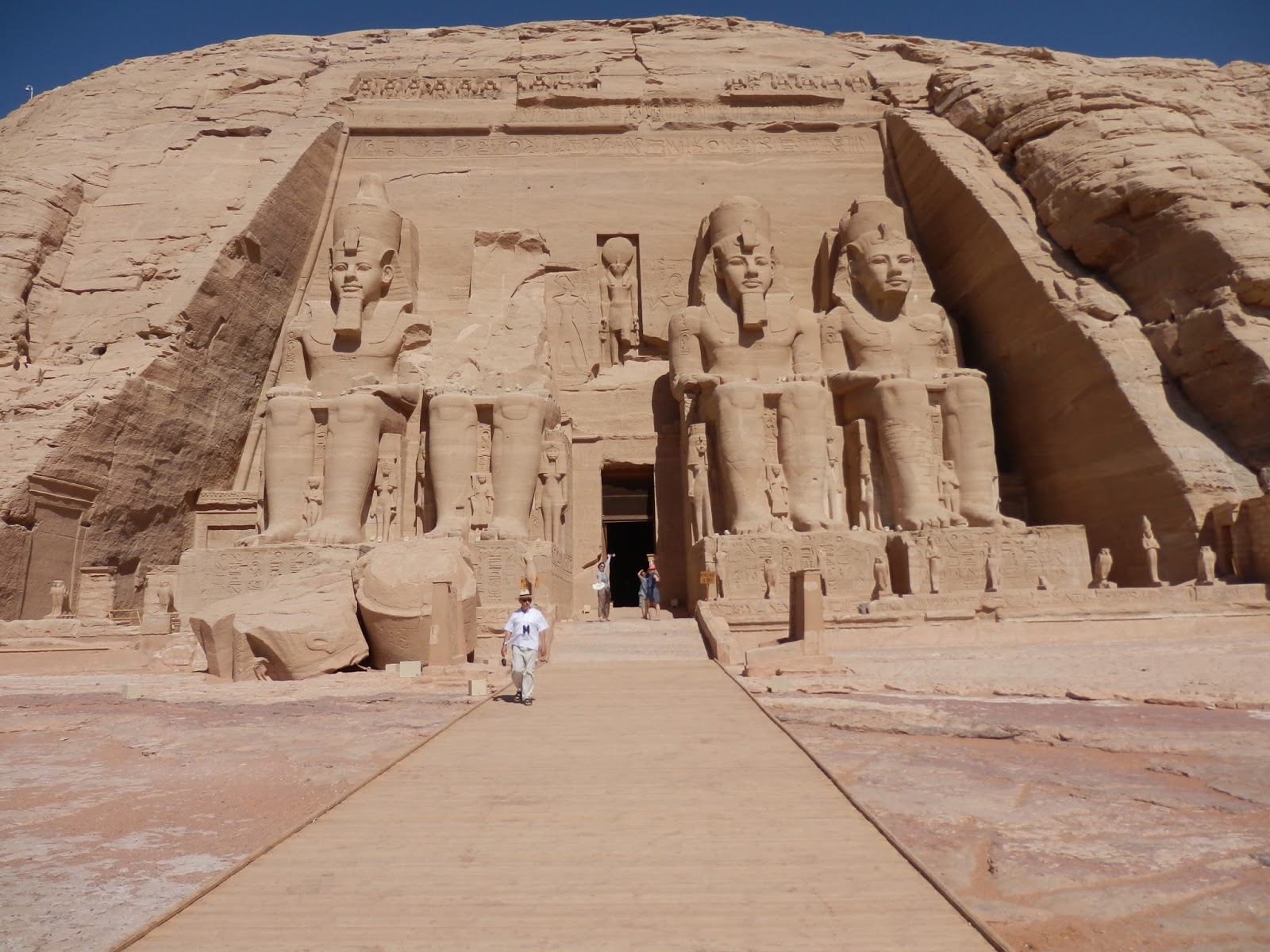
A Morning at Abu Simbel

06 June 2012

During the English Summer Holidays (my friend was a teacher) we decided to undertake a tour of Egypt, because we could. 

Though I have a strange family connection with Egypt, I knew this tour wouldn't cover that. Instead, it was an Ancient History tour, which appealed to me even more. Having grown up reading Egyptian mythology and ancient history in my spare time, I was keen to see for myself the major monuments that exist besides the Pyramids and Sphinx. Included in this were the two temples at Abu Simbel.  


Tuesday, 5 June 2012

Mortuary Temple of Hatshepsut

05 June 2012

In Ancient Egypt, the river Nile created a simple divide of east and west, life and death. To the east the sun rises: life, before dying as it sets in the west.
As a result, despite there being temples located on the east and west shore of the Nile, the purpose of these temples is clearly divided into temples for the living and temples relating to death.

The temple constructed by Hatshepsut, the female Pharaoh is located on the west shore and so it is designated the Mortuary Temple of Hatshepsut.


Sunday, 12 February 2012

Church Bells

There is a strange sense of comfort in hearing the church bells chime the hour and summon the masses to Sunday's service. Curled up on my couch reading the latest news from abroad, the faint din of the bells would drift through the garden to tap at my chequered windowpane. Sitting there absorbed in a world of stories they sing a song of the morning hours.

It's not as though I'm religious at all, but instead it serves to reinforce a sense of community  which we just don't get at home. Even in the outskirts of London, this prevails to remind one that what is now simply SE3 was once the village of Blackheath and the community centred around Westcombe Park manor and estates. Somehow it successfully penetrates through a Sunday morning sky, drowning out the neighbouring dog and creating the illusion that in the surrounding silence everyone is waking from their slumbers, or quietly trooping in to begin the weekly service.

Now that I'm home, I couldn't tell you where my nearest church was, or what denomination it is. I've never needed to know: I've never even wanted to know.

Thursday, 29 December 2011

Off to Bath

27 - 29 December 2011

In the days between Christmas and Caramel returning from Canada, I decided it made sense to make a trip out to Bath.

It was one of these places still on my list, despite visiting with the family more than a decade ago. This is  no doubt initially due to my love of Jane Austen but over the years was embellished and expanded by addition of the details provided in Georgette Heyer's Regency novels.

While London remains contemporary, the Bath I know is that of the Regency Period 1, 1800 - 1820, when Bath was the socially acceptable watering place where invalids and old ladies congregated, creating an insular little society second only to Almacks in London.

I knew about the Baths and the Assembly Rooms - Upper and Lower. The Royal Crescent and Laura Place. I now just wanted to see them for myself, remind myself what they looked like in order that I knew what to imaging when next reading those tales of Bath.

When we'd come with the family, I remember visiting the Jane Austen Museum and the Baths, but inexplicably, the image that stuck most in my mind was that of standing in the park by the river, the columns on one side, a bridge with buildings up ahead and the strange stepped waterfall in the river before us.

Monday, 10 October 2011

A Day at Court - Hampton Court

10 October 2011

Hampton Court is one of those places you just have to include in a historical tour of London. 

It was built by Cardinal Wolsey, right hand man to King Henry VIII before being gifted to the King in 1528 in an unsuccessful bid to halt his downfall. This occurred the following year though Wolsey did not live much longer, dying in 1530 as Henry VIII began expanding Hampton Court to make it a suitable residence for his court. 

By the time Henry acquired Hampton Court, Wolsey had already undertaken extensive renovations. He wanted it to be a suitable show of his power and position, and also a place where he would be proud to entertain his King and foreign dignitaries. Wolsey added a new entrance courtyard, a long gallery overlooking new gardens and lined many of the rooms with fine tapestries acquired whilst on a diplomatic mission to France. 

Related Posts Plugin for WordPress, Blogger...