Monday, 28 April 2014

Researching Rome

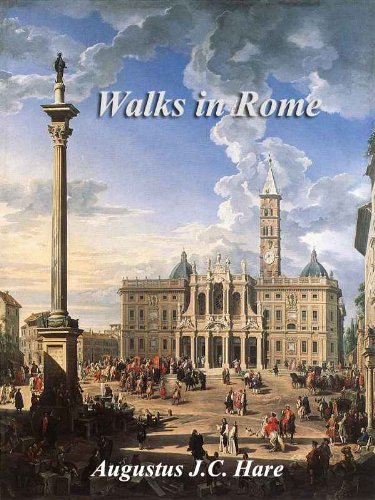
This cover depicts the Santa Croce in
Gerusalemme Basilica
I've started writing a new novel, one set in Rome in 1880 and so in order to understand the setting I'm consulting the guide books and maps of the time. I want to know what had been discovered, what had been built, how did English tourists travel, where did they stay, where was church... and its proving very interesting.

Rome was a popular destination, away from the cold misery of the English climate, a place where there seem to have been less social restrictions, and where the more intellectually inclined could review their classical education or perfect the art of painting sunny vistas and picturesque ruins.

With the guide books no longer under copyright I've loaded up my kindle and am slowly compiling lists of attractions and relevant quotes regarding them. For while I know what intrigued me on my visit, these places were not necessarily available 130 years ago; they may not have been created as a state-of-the-art museum collection,  or may still be being preserved by the build up of 2000 years of Roman soil.

Thanks to these marvellous books I know that like the Count of Monte Cristo, English tourists preferred to stay in the area around the Piazza di Spagna - the square at the bottom of the Spanish Steps. It was here too that the artists' models would wait for work, lounging upon the sunny steps.


Saturday, 19 April 2014

Cooking up a storm... again.

I find cooking a relaxing hobby.

It's a little strange perhaps, but it is something to which I can give my full attention, ignoring the stresses of life and allowing my mind and body to focus on the task at hand. This in itself acts as a form of meditation whilst at the same time feeling more productive than meditation or yoga.


The only down side is that the food prepared needs to be eaten and is often in the form of cakes and biscuits, the majority of which a small family of three has no possible chance of finishing themselves. Then of course there's the added bonus of suitable praise being heaped upon the cook when the outcome of the cooking is shared with family and friends.

I'm joined in this love of cooking by my sister and Claire and so occasionally we join forces and whip up a feast or two that family and friends are then co-erced into eating. The first occasion was a good few years ago now, an Algerian feast prepared over two weekends and eaten in appropriate style, on rugs and cushions piled around a long table placed on the floor and covered with food.


With the sheer amount of food we plied people with, it wasn't surprising when a number of guests settled down for a snooze in order to digest their mains and prepare themselves for the dessert course.

It's a dreadful habit of ours, but with a delight in feeding grateful people, we organised another feast; this time for the members and partners of our Playwriting group.

The menu for this evening wasn't extensive but then we only had 24 hours to prepare it as opposed to the two weekends of previous occasions, and we only had 12 people to feed.

Kale and Fetta triangles
Kale and Fetta filo quiches

Saffron Chicken with Tah Dig (Crunchy Rice), Salty Salsa and Herb Salad
Goat Curry
Chinese spiced Roasted Pork Belly
Cauliflower puree
Roasted pumpkin and beetroot
Beans with mustard cream
Bread

Chocolate Mousse Cake
Chocolate Truffle Cookies
Tea Biscuits
Devonshire Tea
Fruit platter

(This was augmented with a Bloody Mary Casserole and a
delightful selection of nibbles and drinks provided by our guests)

Raw Ingredients. 
We'd started marinading the pork and cooking the goat the evening before to ensure more intense flavours
.
Grinding the saffron for the chicken.

Arguing with the filo pastry for the triangles. Each piece should be cut into three and then
 rolled to created filled triangle parcels. Provided the filo behaves correctly...
Goat Curry, complete with marrow bones.

Claire and I have both been given the Flavour Thesaurus for our birthday by friends and this marinade evolved from the combinations therein. Bay leaves, peppercorns, juniper berries, coriander seeds, star anise, soy sauce, Chinese rice wine vinegar.


Not being a fan of potatoes the roast veggies were restricted to pumpkin and beetroot. Ready to go into the oven.

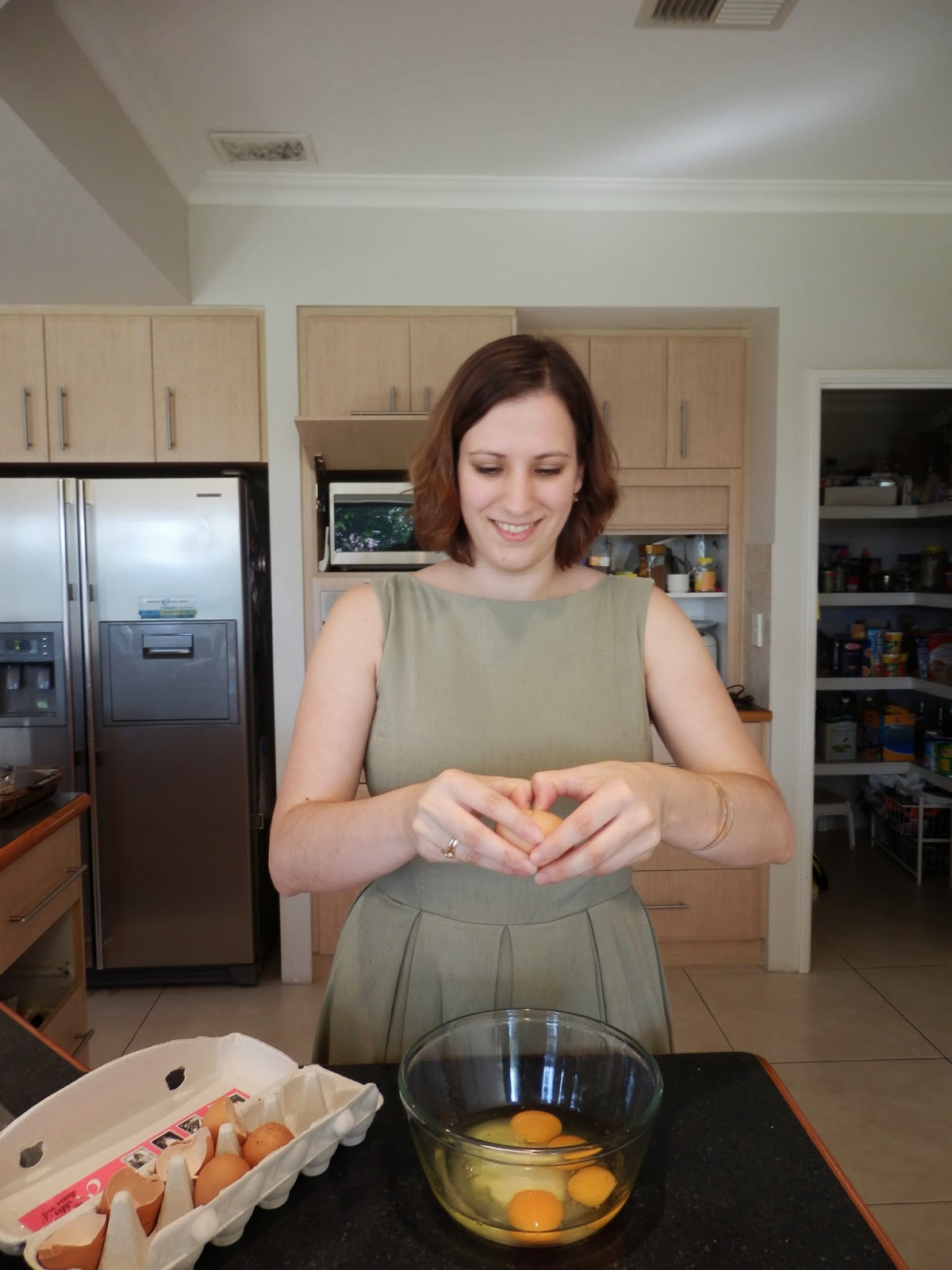
Whisking up the chocolate cake: eggs sugar...
cocoa powder, lots of chocolate and butter. 
Worth it!
The chocolate mousse cake is a tried and tested French recipe with no flour, just a lot of chocolate, butter and eggs. Pure decadence. I had been hoping to flavour it with cardamon, but the powders I found in the kitchen were so old they'd lost all association with the spice. Next time.

Tea Biscuits
The tea biscuits are supposed to contain Earl Grey or Lady Grey tea, pulling in the citrus and bergamot flavours. I didn't have any though so I used a combination of herbal tisanes floating around the house. What it resulted in were beautiful 'hippy' biscuits flavoured with chamomile, lavender, mint, white pear, rose petals and lemon balm.

At 16:00 two of our guests arrived for a political discussion with scones (and jam and cream) to be joined a few hours later for the main meal and program of entertainment.

On a previous occasion we resorted to small amounts of alcohol to ensure our guests mingled properly as opposed to remaining in their own small little groups.

On this occasions no such 'persuasion' was required.


Dessert


The only dis-satisfied guest. 
It was a delightful evening. Now to determine the theme for our next feast...


Sunday, 6 April 2014

Woodbridge, Guildford

Woodbridge was one of those places I discovered in the process of researching my novel: a Victorian/Federation house in the Guildford area, much like the fictional ones I was creating. 

That was X+1 years ago and I am ashamed to say that it took until this year's Heritage Festival for me to finally make the trip out.  


Woodbridge was built in 1885 by Charles Harper, a gentleman farmer also involved in politics and part owner of the West Australian newspaper with John Winthrop Hackett. It was where he and his wife Fanny de Burgh raised their 10 children, Guildford Grammar School started (as a response to his sons unruly behaviour on the train in to Hale) and where he managed his sheep/wheat/orchard estate. 


As is appropriate for a Victorian/Edwardian living room, there is a considerable amount of furniture scattered around the room. Though this house doesn't date to the 1860s, my favourite combination is that of crinolines and these overcrowded rooms. Particularly spindly tables like the one in the centre of the blue suite in the pic below. 


Scattered throughout the formal rooms here are a series of vases decorated with three dimensional flowers and leaves. Supposedly they have been verified as Rockingham Ware though as I can find nothing remotely similar online they appear to be exceptionally rare and may have been commissioned for or gifted to the Harper family. (Un)fortunately, though these are all slightly broken, they are still in working order.


The Dining Room:

The Morning Room:
Presumably Fanny's sitting room, with just enough room for her husband to join her for tea from his adjoining study. 

Charles Harper's Study.

Separating the dining room and formal rooms  from the kitchens, this passage/vestibule had originally been left open to allow a through draught to cool the house down. This was mirrored on the first floor, separating the children's day room and boys bedroom/dressing room from the rest of the house, no doubt a sensible noise-reduction design.

The kitchen.
I just love the saucepan stand though I know it would be a challenge to lift each one, hot and filled, off the stove. The scullery, store room, and meat room were all separate and accessible through the doors at the back of the kitchen. A door to the right led out to the side veranda and kitchen gardens.
In the background is a Coolgardie safe, a butter churn and an icecream churn (I've forgotten some of the other features but it was a well stocked/cool cooking space.

Though the house is only two stories, the stairs continue winding up to the tower and providing limited access to the storage space in the roof and the roof itself.

Perhaps the only disappointing thing about Woodbridge was that though it presented itself with such beautiful verandahs and wrought-iron balustrades, visitors were not granted access to any of these areas. Even the tower at the top of the flight of stairs was out of bounds.

The floor plan of Woodbridge as it is currently laid out.

The Nanny's Room, leading through to the nursery.

The Nursery.
With ten children, this room would have been occupied for a great many years.

The main bedroom:
The suite (consisting of a tallboy, cheval mirror, bedside tables, dressing table, wash stand and a wardrobe) was purchased on Charles and Fannys' honeymoon to Melbourne, and is constructed from the prized Tasmanian Huon Pine

In an old dressing room there are a few museum cases containing artefacts that belong to the family, incuding this beautiful piece of lace. 

The Music Room.
Originally this was the bedroom shared by the four daughters of the house. Not exactly my idea of fun, particularly as experience has taught me the further my sister and I are from each other the better we get along.

The children's day room.

Throughout the house the walls have been simply whitewashed and we wondered if this was accurate for the time of the Harper family's residence or a remnant from the house's later uses. With the whitewashed architraves and doors, this jarred slightly and it wasn't until we reached this day room that we surmised that in actuality the woodwork throughout the house would have been left natural. This was reinforced by the natural colouring of the internal balusters and handrails, and the fact that all of this wood was supposedly imported from England.


Due to the house's location, surrounded on two sides by the river, a rose garden on the third and the front drive completing the square, it is encapsulated in its own little world, for the most part screened from the business end of the property's functions.


However in days when the surrounding gums where smaller and sparser, the verandahs provide superb views over a flood plain that is now the Guildford Grammar playing fields but no doubt were once covered in rippling wheat or were grazing ground for the sheep. 


Beyond a small patch of grass is a little inlet, no doubt in former days used as the childrens' swimming hole or to enable them to go boating away from the traffic that frequented this stretch of the Swan and necessitated the jetty below (unless that was installed more recently solely for wedding parties). 


The garden here is relatively sparse, probably for ease of maintenance and is more ornamental than anything, shielding the cafe from the main house. However it was delightful to see that if you knew your plants you could identify the few stubborn fruit trees and vines that once demarcated the kitchen garden. 


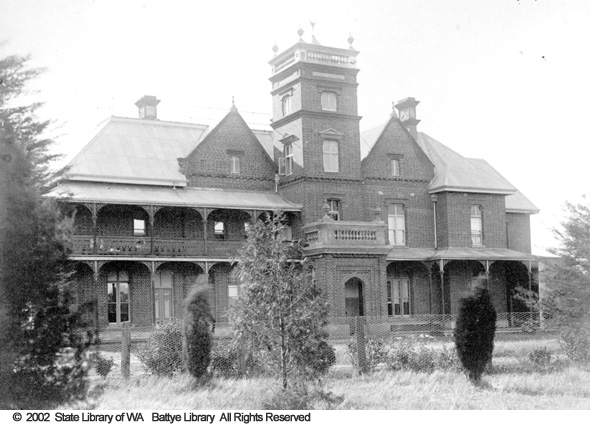
Woodbridge in 1894. 

Wednesday, 2 April 2014

Writing(,) a self-examination

In response to Claire's tag and a curiosity for a self-examination of my writing process, here goes:

What am I working on now?

My first novel was a lengthy process, a gradual learning curve that has finally reached the stage of final draft and is awaiting distance and feedback for a major re-write of the introductory chapters. It incorporated responses to emotional situations in my own life, only centred around a different set of characters living in a different time period. Currently, it's sitting on the back-burner, awaiting the time when the characters stop being intimate acquaintances. As this distance is being achieved, I have moved on to begin writing two more novels, whilst maintaining a sporadic presence in the blog-o-sphere. 

Both 'new' novels are in the embryonic stages with characters still faint watercolours and the plot sporadic moments loosely woven together with as yet no discernible underlying structure. Which one I work on is dependant entirely on where my head is at (which story has of its own accord worked its way forward through the tangle of information and interests in my brain and is consuming my down time). The reason there are two novels in existence at the moment is that the first stemmed from travels during the summer of 2012 while the second is partially centred around the lives of my deceased grandmother and frail grandfather they first arrived in Fremantle. Given the health of my grandfather and his siblings and in-laws this novel has an element of urgency about it which partially instigated the decision to move this novel into the foreground. 

Almost as a result of this urgency, the first novel has currently taken over my mind, pulling me toward Rome and the Greek Islands, and allowing me to reminisce about my time in Europe and travelling the Mediterranean whilst wondering on the differences (the new discoveries, new creations, demolitions) that have occurred in the last 100/150 years. 

And the blog posts? They happen sporadically, in response to things that happen in my life that I want to share with friends, or reactions to events that need to be verbalised but with an element of abstraction and not directed at anyone specifically. Only recently has this caused my academic writing to rear up, but there is not yet the motivation or incentive to return to that world. 

I'm supposed to also be working on a monologue on 'Windows', but that's not happening: the inspiration never hit me and I was too involved with other things.


How does my work differ from others in its genre?

I'm not sure I know. I don't tend to read contemporary works of a similar historical nature, preferring instead works by (female) authors now deceased. Of these dead white females, some have proven inspirational and I have marked up one particular novel as though I were back in English Literature classes again, but I don't intentionally mimic the style of any author or even look for comparisons when I'm writing. If this happens in the editing process, great. Sometimes that might be enhanced, other times it fades to a shadow, intentionally taunting readers to delve deep enough to discover it. 

Reading back over my writing and listening to some of the feedback, I think my writing style is simplistic but historic; I have never excelled at theoretically writings and often find myself tuning out when (attempting) to read them. Instead I prefer to use language (often with an historic syntax) to paint a scene, or enable a reader to feel themselves witness to a fast and witty conversation. To a modern audience this can prove a little inexplicable, but I've always been more of an historical person than a modern one. 

Of the characterisation and setting, they usually tend to be strong interesting characters in typical everyday settings focussing not so much on how to extricate themselves from unusual situations, but instead how they cope with the expectations and emotions placed upon them by their social and familial situations. Having moved on from a single novel, I find the recurring elements are that each story is historical in some way and centred around an independent young female who is in the process of discovering herself and her position in the world and cementing herself within this position. To some extent I try to replicate the social commentary of novels like Wharton's Age of Innocence, even if I am creating the society from scratch or imposing elements of a modern day society onto what I understand to be an Edwardian society. 


Why do I write what I do?

My first novel was written because I had a world of characters alive in my head and I wanted to record their lives in a manner that was enjoyable and entertaining for me, with only the added bonus if it was enjoyable to others. For many years it was a personal hobby unbeknownst to everyone bar my sister and possibly my cousin (both inspirations for the characters). Only recently have I let others in to inspire and nurture the story and motivate me to turn this recording of individual stories into a more coherent novel. 

In my novels I write because I have a story I want to record. Be that a fictional world that's taking over my life, the story of my ancestors who very soon will no longer be able to communicate their stories; stories which will subsequently be lost forever, or a scenario that enables me to combine several different interests in a manner that inspires additional intriguing research to fully understand the setting upon which I have decided. 

The blog is a way of recording feedback to the world around me that does not fit within the confines of developing novels. With a love of the written word and photography, a blog seemed like the ideal way of combining both in a fluid form that was available to a wider audience (those of the anti-facebook persuasion). Often posts takes the form of recording the beauty of the world around me, be that the life in the garden on my doorstep or the joys of introducing my cousin to elements of nature. However on other occasions it has also provided a medium through which to vent my frustration at events which I have no right to comment on but want to nevertheless, or respond to things discovered on the world wide web. It is also a way of trying to keep my hand in, in times when a desolate winter has set in, affecting the motivation and inspiration to write both novels. 

Although I have been told that, like a monologue, a blog is written with an intended audience in mind, I find I'm not writing for someone else. The occasional post is directed at a friend or two but for the most part I write for me. The blog is a way of setting a quality threshold and storing my writing somewhere where others can access it if they feel like reading it (as opposed to in the depths of an obscure folder on my computer). If it pleases people or creates discussion/lengthy rants, even better.

What I don't write into my blog, as much as I would like, are recipes. This omission is perhaps strange to those who know me, but I find that (in comparison to blogs like smittenkitchen.com) my food photography and the written recipe do not live up to the reputation of the food when it is made and served to family and friends. As a result, though recipes are handed out to all and sundry, they are only infrequently recorded here. 


What is my writing process?

I'll admit, I'm not religious about it. I write whenever I can, when the inspiration hits me. This means carrying around a wad of paper and a pen in my handbag on almost all occasions, using the backs of exercise books in boring meetings, and keeping paper and a pen on my night-stand for those moments of inspiration that hit just as I'm drifting off to sleep. 

For my novels, I find writing with (a good) pen and paper to be a more inspirational method than trying to write directly into a computer. However what is interesting is that this does not apply to writing for the blog.


To satisfy my own curiosity about their writing styles If they so desire, I nominate Christine and Ash.lee to continue the interview and answer these same questions themselves.

Related Posts Plugin for WordPress, Blogger...