Showing posts with label Food of the Gods. Show all posts

Wednesday, 21 January 2015

Mango Lassi Tart

It was my first day back in the kitchen after a couple of months in Europe.
I'd been asked to make a dessert for a lazy chicken and salad dinner with family.
As it's the middle of summer here, I didn't want anything hot or stodgy. It needed to be light and refreshing and relatively quick to make.
Now I had thought of making a cheesecake, but between shopping for the ingredients, making it and leaving early so we could have a swim before dinner, I didn't really feel I had the time.
So instead I made a variation on a Pannacotta (a suggestion of Mum's). They were flavours that were not only readily available to me, but according to my Flavour Thesaurus went well together. Not that the latter was really necessary as Mango Lassis, Barfi and Pina Coladas provided more than enough evidence as to how the flavours would work. Essentially, this is cardamon pannacotta resting in a coconut crust and dressed with fresh ripe mangoes.

Saturday, 11 October 2014

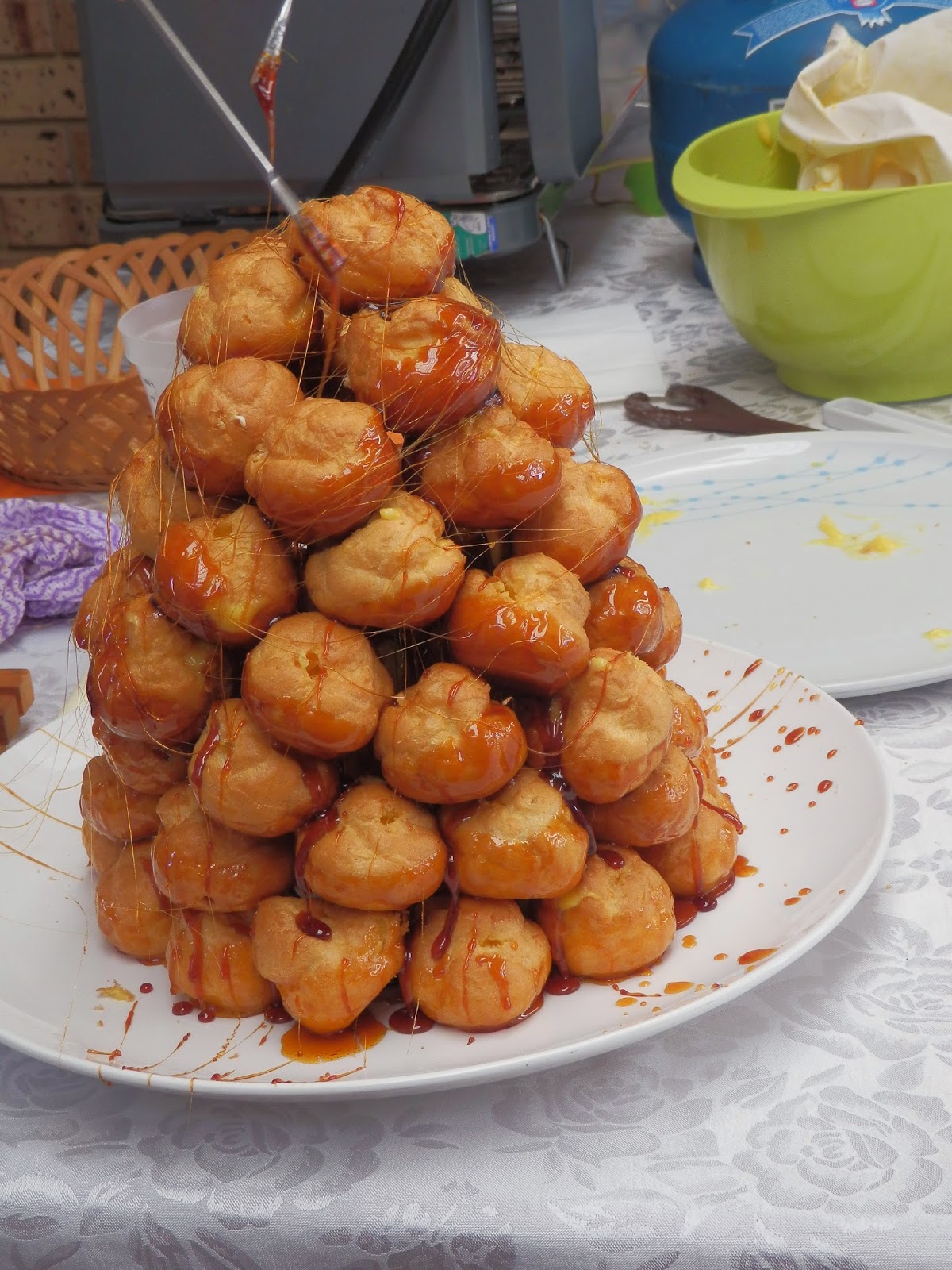
Constructing a Croquembouche


Having made a Croquembouche years ago from my neighbour's engagement party, her mother decided that for a high tea she would like a demonstration of the process in order to impress the ladies invited.

Recovering from the initial shock, (the last time I'd made such a monstrosity was approximately five years ago) and requesting time for a trial run (my cousin's christening cake) before making a decision, I agreed to the challenge and set about preparing. Ingredients needed buying, components preping, nerves steeling.

Demonstrating it in front of a last group was not the problem. What I didn't want to happen was for the croquembouche to fall apart on the day.

It had happened to the one made for my sister's 21st and while we knew why, I was only 99.9% sure that was the reason.

On the day my neighbour's youngest (a talented baker in her own right) helped with the construction as it is a process that requires speed and attention to detail and the hands of the Hindu goddess Durga.


A croquembouche comprises of three separate components.
  • Profiteroles. If making your own you will need to make a double batch of the recipe below. However because I started making croquembouches before I started making profiteroles and because you need the profiteroles to be completely dry and sturdy I use small shop bought ones. I find my home made ones are currently too delicate and often contain uncooked dough even when baked for them to be reliable enough. The shop bought ones can be difficult to find but check the section with the vol-au-vent cases. The image on the right is what you'll be looking for. 
  • Custard. You can fill the profiteroles with whatever you want: whipped cream, chocolate mousse... I use an orange sour cream custard. In order to fill 40 profiteroles you will need about 6 cups of custard. This would be a triple batch of the recipe below. In order for the profiteroles to stay hard for longer and therefore make it easier to construct the croquembouche, make the custard the night before in order that it can cool thoroughly. 
  • Toffee. A single batch of the recipe below will be more than enough. This is easiest to make with a sugar thermometer to accurately measure when the sugar reaches the hard crack stage. 

Profiteroles (makes 20)
1/2 cup (125ml) water
60g butter, chopped finely
1 tablespoon caster sugar
1/2 cup (75g) baker's flour
3 eggs
1 tablespoon icing sugar
  • Preheat the oven to 220C. Grease oven trays (I use baking paper) 
  • Combine the water, butter and caster sugar in a medium saucepan; bring to the boil. (the butter is finely chopped so it melts quickly before the water evaporates. 
  • Add flour; beat with a wooden spoon over medium heat until the mixture comes away from the base of the saucepan and forms a single ball 
  • Transfer pastry to a medium bowl; with a wooden spoon beat in two of the eggs, one at a time. 
  • Whisk the remaining egg with a fork; beat enough of the egg into the pastry until it becomes smooth and glossy but still holds its shape. It should gently fold over itself when the spoon is removed. 
  • Drop level tablespoons of the pastry, about 5 cm apart onto trays. (you can use a piping bag but two spoons works just as well). 
  • Bake puffs for 10 minutes. Reduce oven temperature to 180C; bake 15 minutes 
  • Cut a small opening into the base of each puff; bake a further 10 minutes or until the puffs are dry 
  • Cool on trays.
*for the croquembouche the profiteroles need to be very dry.


Orange Custard (makes about 2 cups)
This custard needs to be cold when used to fill the profiteroles, so make it the day before.


2 tablespoons custard powder
1/4 cup sugar
1 1/2 cup orange juice
1/4 cup sour cream
1 tablespoon Cointreau
1 teaspoon grated orange rind (optional)
  • Combine the custard powder and sugar in a saucepan; gradually stir in the orange juice. 
  • Heat the mixture and constantly stir until the mixture boils and thickens. (It needs to be a little more solid than pouring custard for the profiteroles) 
  • Stir in the sour cream and liqueur and mix well to remove any sour cream lumps. 
  • Serve hot, or allow to cool completely for the profiteroles. 


Toffee
2 1/2 cups white sugar
water to moisten sugar (about 1/4 cup)
  • In a medium saucepan, pour sugar and wet with a small amount of water. 
  • Over medium heat, let the sugar warm, and begin to dissolve. Allow sugar and water to gently boil until the sugar begins to change colour. During this time, brush the inner sides of the pot with a pastry brush dipped in cold water to prevent any build-up of sugar crystals. 
  • Do not stir the sugar but if necessary swirl the saucepan to mix developing sugar crystals under or mix the colour changes throughout the pot. 
  • As soon as the sugar begins to change colour (this is 'hard crack' stage and occurs at 300-310 F (I use a sugar thermometer)), remove from stove and place on a heatproof surface (an oven mitt can be used) near your work area. 

Croquembouche
  1. Make the custard the day before. 
  2. Make the profiteroles and allow to cool and dry completely (alternatively, use shop bought ones). 
  3. Put aside three profiteroles. Pierce a hole in the side of each of the remaining profiteroles. The hole needs to be large enough for the nozzle of the piping bag but not too large).
  4. Chose your platter and work out where the bottom ring of profiteroles are going to be placed. Once they are stuck down with the sugar they can not be moved.
  5. Prepare the toffee (see the recipe above) 
  6. This step needs to be done in tandem, one person doing the custard, the other using the toffee so that the profiteroles don't have a chance to soften with the custard before they are glued down. Fill a piping bag with the cold custard and start filling the profiteroles one at a time.
  7. The moment a profiterole is filled, dip its bottom into the saucepan of toffee and glue it in place on the platter.


  8. You want to place the hole facing in to the centre of the circle. You may have to hold it in place for a few seconds until it sets. 
  9. Continue to complete the first ring of profiteroles.
  10. Start building up, remembering to come in slightly with each level so that it tapers in to form a pyramid.


  11. As you get to the last few profiteroles, return to the three you put aside. Determine where to place the hole so that it will be hidden when on the pyramid (this may require placing it in the bottom of the profiterole). Fill and glue as before.
  12. If the toffee starts to harden you may need to re-melt it. Be careful as each time you reheat it it will darken in colour and taste. 
  13. Once the pyramid structure is complete, dip a whisk or fork in the remaining caramel. In a circular motion, trail threads of caramel over the top and down the sides of the croquembouche.
  14. Decorate with edible flowers and ribbons as you're spinning the toffee on to the croquembouche. (Use the toffee to glue the decorations in place). 


Saturday, 20 September 2014

Preserving Lemons

Preserved Lemons are one of those things that are ridiculously expensive given what they are and how easy they are to make.
Essentially they're just lemons cut up enough to have the juice squeezed out and salt squeezed in. They're then left in their own salt enriched juices to mature for a few months, preferably in a cool dark place.

With an annual abundance of limes I keep meaning to make them, but never do.
Until this year... finally.

It's not as though we don't need them, or wouldn't use them for they are always the missing ingredient when we make Moroccan and Dad likes to cook his chicken in the juices.

I don't know whether it was that finally I had a set of jars to use, I was more confident with the sterilisation process, had fewer other ideas for how to use the fruit...
but they're now bottled to await the long maturation in storage process.

Half of the limes undiced:

Half of them diced. Each recipe seems to have a preferred method of cutting them, be it in sixths, eighths or fluted at one end while kept whole, the salt squeezed in through the open end. I'll admit, I was lazy and just cut them in a simple easy manner so that they would be easy to juice, easy to press the salt in and easy to pack into a jar. 

Squeezed, salted and thoroughly mixed,

before being packed into a jar with the salty juice poured in over.

These will be dumped in the back corner of the pantry and forgotten about, so let's wait and see how they turn out in a few months. 

The Recipe: 


Saturday, 19 April 2014

Cooking up a storm... again.

I find cooking a relaxing hobby.

It's a little strange perhaps, but it is something to which I can give my full attention, ignoring the stresses of life and allowing my mind and body to focus on the task at hand. This in itself acts as a form of meditation whilst at the same time feeling more productive than meditation or yoga.


The only down side is that the food prepared needs to be eaten and is often in the form of cakes and biscuits, the majority of which a small family of three has no possible chance of finishing themselves. Then of course there's the added bonus of suitable praise being heaped upon the cook when the outcome of the cooking is shared with family and friends.

I'm joined in this love of cooking by my sister and Claire and so occasionally we join forces and whip up a feast or two that family and friends are then co-erced into eating. The first occasion was a good few years ago now, an Algerian feast prepared over two weekends and eaten in appropriate style, on rugs and cushions piled around a long table placed on the floor and covered with food.


With the sheer amount of food we plied people with, it wasn't surprising when a number of guests settled down for a snooze in order to digest their mains and prepare themselves for the dessert course.

It's a dreadful habit of ours, but with a delight in feeding grateful people, we organised another feast; this time for the members and partners of our Playwriting group.

The menu for this evening wasn't extensive but then we only had 24 hours to prepare it as opposed to the two weekends of previous occasions, and we only had 12 people to feed.

Kale and Fetta triangles
Kale and Fetta filo quiches

Saffron Chicken with Tah Dig (Crunchy Rice), Salty Salsa and Herb Salad
Goat Curry
Chinese spiced Roasted Pork Belly
Cauliflower puree
Roasted pumpkin and beetroot
Beans with mustard cream
Bread

Chocolate Mousse Cake
Chocolate Truffle Cookies
Tea Biscuits
Devonshire Tea
Fruit platter

(This was augmented with a Bloody Mary Casserole and a
delightful selection of nibbles and drinks provided by our guests)

Raw Ingredients. 
We'd started marinading the pork and cooking the goat the evening before to ensure more intense flavours
.
Grinding the saffron for the chicken.

Arguing with the filo pastry for the triangles. Each piece should be cut into three and then
 rolled to created filled triangle parcels. Provided the filo behaves correctly...
Goat Curry, complete with marrow bones.

Claire and I have both been given the Flavour Thesaurus for our birthday by friends and this marinade evolved from the combinations therein. Bay leaves, peppercorns, juniper berries, coriander seeds, star anise, soy sauce, Chinese rice wine vinegar.


Not being a fan of potatoes the roast veggies were restricted to pumpkin and beetroot. Ready to go into the oven.

Whisking up the chocolate cake: eggs sugar...
cocoa powder, lots of chocolate and butter. 
Worth it!
The chocolate mousse cake is a tried and tested French recipe with no flour, just a lot of chocolate, butter and eggs. Pure decadence. I had been hoping to flavour it with cardamon, but the powders I found in the kitchen were so old they'd lost all association with the spice. Next time.

Tea Biscuits
The tea biscuits are supposed to contain Earl Grey or Lady Grey tea, pulling in the citrus and bergamot flavours. I didn't have any though so I used a combination of herbal tisanes floating around the house. What it resulted in were beautiful 'hippy' biscuits flavoured with chamomile, lavender, mint, white pear, rose petals and lemon balm.

At 16:00 two of our guests arrived for a political discussion with scones (and jam and cream) to be joined a few hours later for the main meal and program of entertainment.

On a previous occasion we resorted to small amounts of alcohol to ensure our guests mingled properly as opposed to remaining in their own small little groups.

On this occasions no such 'persuasion' was required.


Dessert


The only dis-satisfied guest. 
It was a delightful evening. Now to determine the theme for our next feast...


Wednesday, 1 January 2014

Market Cravings

I want to go back to Spitalfields Markets, the one near Liverpool Street Station.

It's not because there's a chocolate shop there; there is and it has some rather nice truffles, even if I do say so myself.
But it's because of one of the stalls there, a baked goodies stall piled high with a delectable array of sugary goods. However there is one thing in particular that stands out; the pyramid of Loukoumades, deep fried doughnut balls drenched in a honey syrup.
With a paper bag of six, I'd wander around the remains of the market nibbling on each one in turn, savouring the crunchiness and the contrast with the eruption of the syrup into your mouth when each one was bitten into.
They never did last long enough for me to get a photo.

The other market I miss is Borough.


It is the foody market in south London, providing tables of fruit and vegies, fresh seafood, baked goodies, olives, lollies, meat (fresh and preserved), cheeses, bags of assorted chocolate truffles... all clustered near Southwark Cathedral under the tracks leading north from London Bridge Station.


It also possessed a tangle of alleys lined with stalls from which one could procure the most delicious food, provided one was willing to join the end of each queue. It felt as though there was everything under the sun, including exotic hamburgers, melted cheesey potatoes, paella, fresh oysters...

However my absolute favourite was the caramelised duck and rocket with hot mustard on ciabatta roll. It was from one of the many stalls with a lengthy queue, but the moist sticky flesh, full of flavour, teamed with the bitterness and heat of the rocket and mustard are amazing; one of those dishes that others see and wish they'd bought themselves.


Always a fan of duck, I discovered it on my first trip to Borough Markets and must admit to buying it again and again on each subsequent trip.


When the crowds inevitably became too much, we would gather together our purchases and begin the leisurely stroll upstream towards the Tate Modern and St Paul's, or cross the Thames to wander in search of a sunny bench where we could sit to enjoy the rest of our treats.

Caramel about to devour a Portuguese Custard Tart 

... provided the ravens don't steal them from you.


Related Posts Plugin for WordPress, Blogger...