Showing posts with label Fashions of the Past. Show all posts

Monday, 29 June 2015

So as not to go to waste

Living in London, I bought some work shirts. Crisp, fitted cotton shirts with good sturdy collars and cuffs.
Only problem, before long while the arms fitted, the neck fitted, the waist fitted, even the shoulders fitted, my 'ample' bust did not. By a good 4 inches.

To say I was slightly miffed was an understatement. They had fitted when I'd bought them, naturally, but a combination of a luxurious lifestyle and birth control meant that before long, they didn't.

One faded away, fraying at the seams in a way that meant nothing could be done to it to make it fit again. The others were simply too delightful to throw. After all, I'd gone to pains to chose a delightful selection. One was snow white, another with a stiff V neckline, but my favourite was white, with vivid green satin stripes down it's length.

Not wanting to waste them (they reminded me so strongly of the stiff shirtwaists of the Edwardian era), I kept them, neatly folded away in a suitcase in London, packed them into the tea chests carefully nestled amongst the numerous shoes and transported them half way around the world, supposedly never to wear them again, before packing them again into a hat box to store on the top of my wardrobe.

Monday, 23 March 2015

Mystery of the Silver Container

Yesterday, Mum and I headed into town to check out a small exhibition of antique Georg Jensen pieces. We'd been exceedingly fortunate to even hear about it though a jewellery designer friend who happens to work at Georg Jensen, because it was not advertised anywhere.

Wednesday, 4 February 2015

18th Century Embroidery

On my latest trip to Europe I was fortunate enough to find a couple of museums with historical fashions on the floor.

Usually historical fashions are few and far between particularly as for every few months on display they are ideally required to spend a few years in deep storage to counterbalance the impact of the light and heat on the delicate fabrics. As a result, some museums are only open when they have a temporary exhibition on.

Other historical fashion collections are not even given their own museum, but are discretely incorporated into cultural or 'time period' museums with little or no external reference even to the existence of the collection within.

On this trip I had discovered a few small references to these collections which ensured my determination to see them. I was not expecting them to cover the same field. The first exhibition was Fashion Unframed at the Bayerisches Nationalmuseum, Munich, and the second part of the permanent exhibition at Palazzo Mocenigo, Venice.

Monday, 5 January 2015

Controlled attempt at getting lost - Venice

On the ferry back from Burano I got talking to an old Italian who told me that to appreciate Venice you have to get lost in the streets. While I can understand the sentiment, a) most of the streets I've discovered thus far are not interesting enough to want to get lost in them, and b) I don't like the idea of giving up that level of control.


As a result, though I tried to explore the south island I don't think I was all that successful. It may have been that it was still rather early, but it's as likely that I was not wandering along the beaten path and so the streets simply weren't catering for tourists.

Saturday, 3 January 2015

Ca d'Oro & Palazzo Mocenigo - Venice

I arrived in Venice at 10 am having left Barcelona at the slightly unseasonably hour of 7:30 am. Being unable to check in until the afternoon, and not wishing to waste a day, I dumped my luggage and went in search of sights and information.


One of the things I wanted to do during my stay was make a day trip to Murano and Burano and I also wanted to see if there were any museums/things worth seeing that I had not yet discovered in my cursory search of Tripadvisor and Wikipedia. As a result. the information centre was my first stop. It was not as useful as I'd hoped though, which was perhaps a good thing as I'd already discovered enough things to keep my days filled.


Thursday, 18 December 2014

World War Wardrobes

It's often exceedingly difficult to get to many of the fashion exhibitions that sporadically grace the museums around the world. As I mentioned earlier, there was a Charles James exhibition in New York that was impossible to get to, and years ago  it was not my trip to Paris but my sister's that coincided with a Second Empire fashion exhibition (she was kind enough to get me the book).
In addition there are several museums that only ever host temporary exhibitions and so remain closed between exhibitions, often over the winter months when I happen to be traveling.
As a result, being in Berlin when the Kreig und Kleider: Modegrafik zur Zeit des Ersten Weltkriegs (War and Clothing: Fashion Illustrations at the time of the First World War) exhibition was on, I treated myself to a visit.
Then, given it was also my birthday (the perfect excuse) I also treated myself to the book.

While World War One fashion is not my favourite era, it is an interesting time that is rarely covered in detail. This is because it falls between the opulence of Belle Epoque which simmered down after the death of Edward VII of England in1910, and the Twenties where fashions were so dramatically different as to shock. It was also interesting to view as the exhibition focused solely on the representation of fashion be they through photographs or fashion illustrations, the later of which I focused my Honours thesis on.

This particular exhibition was looking not only at the changes to fashion from 1913 through the War, but also the differences between the fashion centres of Paris, Berlin and Vienna as Berlin particularly found itself on the other side of the War from Paris and subsequently turned inwards to promote its own designers and manufacturers.

I thoroughly enjoyed the exhibition in its own right as it contained a sizable range of documents which were beautifully displayed around the room. Saying that, a few of the illustrations inspired me to look at the exhibition from a wider viewpoint, comparing the fashions illustrated within with the fashions of the Second World War and after. Differences and similarities seemed to imply that the role of fashion differed in each War.


Before World War One, fashions still bore strong similarities to those of the Belle Epoque; skirts skimmed the ground though they were long and narrow; exaggerated form of the style were referred to as hobble skirts. The bust was still the most emphasised part of the silhouette though, like the skirts it had been exaggerated, and with the streamlined corsets would have been uncomfortable and movement would have been considerably restricted.


With the onset of World War One, several elements changed dramatically. Skirts shortened as much as possible to allow for some element of practicality. Women occupied a greater role in a country's economy than they had previously and this increased movement combined decreased time and manpower within the home would have made the maintenance of  floor length skirts an imposition. This meant skirts became ankle length or at the most 'ballerina' length; however at the same time  they increased in volume. This was possibly to retain an element of modesty so the ankles and suggestion of the shape of the female body weren't being displayed at the same time.


In another move towards increased practicality, the exaggerated bosom of the pre-war years was lost with a more natural bodice coming into effect. Underneath this, corsets started to become softer and more natural allowing for increased natural flexibility and movement.

In this time of war, the military element of life was reflected in the fashion of women. Outerwear became less streamlined and draped but  more severe in its cut, taking on the style and simplicity of military great coats.


When decorations were in order, they took two forms, one being as tassels and frogging, elements that also reference the dress uniforms of the military. This decoration was also evident in the day wear.


The military influence is also noted in the change in head wear. Prior to the war the hats were influenced by the costumes of The Merry Widow, wide enough to cover the wearer's whole body. While this fashion shrunk slightly immediately before the war, there was still a tendency for wide shallow hats.
With the War these became smaller, and more compact, but at the same time taller, with feathers and stiff embellishments that stuck straight up.


What is interesting to note is that were was still a sizable element of frivolity to womens fashion. Skirts had a notably exaggerated volume when compared with those of former years while other elements of an outfit often contained more fabric in the form of layers and pleats. While this softened and padded out the female form, it may also have been encouraged in support of the fledgling local textile industries.

This softness  and fullness was enhanced further by the continued use of laces and embroidery as decoration.


It was as though the delicate softness of female fashion added an element of frivolity and lightness, something that would have assisted to counteract the severity, darkness and depressive outcomes of war. Although the War affected everyone in some form, this was a means to momentarily escape from the horrors that surrounded everyone.


What is most interesting is the comparison of the impact World War I had on fashion with the impact World War II had.  During the Second World War, fashion and more importantly fabrics became incorporated into the home front effort. Fabrics were rationed to the general population and styles controlled to limit the amount of unnecessary usage. For examples, pocket flaps and double breasted jackets were banned, as was a certain amount of volume to skirts (even in the form of gathers and pleats) and the number of buttons used on each outfit. As a result, fashions took a more streamlined appearance, and with women playing a greater role in the workforce, were more practical and 'business-like'. 
In fact, some of the fashions of World War I look remarkably similar to the full skirts of the ''New Look' as opposed to the fashions of World War II itself. The 'New Look' referred to the long full skirts that Christian Dior popularised in the 1950s, a style that marked the end of World War II and rationing and a return to prosperity and an improved economic outlook.


Monday, 15 September 2014

A new Singer in the family.

The sewing machine I've been using till now is a little old. Not quite a hundred year old treadle Singer, but old enough to be showing its age.

My Grandmother or Great-Grandmother's sewing machine, which my mother learnt on. 
In fact my mother bought it the year I was born, and while it survived the t-shirts, bathers, leotards, tracksuits... of our childhood, recently it fell in a heap when confronted with a piece of raw silk chiffon.

So, while it was getting a much needed service, I started researching sewing machines and when Mum brought hers home, I brought one home too. It's not the brightly coloured toy that my sister bought, but I'm happy with it and hopefully it will age as well as Mum's has.


With a sewing machine back on the work bench I got stuck in and finished a couple of projects that had been awaiting the return of Mum's machine.

On the left, the old fabric, on the right, the new. 
First project was a pair of burnt terracotta cushion covers to replace a slightly less appealing set for my Aunt. The couch is comfortable, but needs the terracotta to offset the great expanses of beige tapestry.

They were relatively straight forward; a few rounded corners, overlocked hems and a normal zip (not an invisible zip) in each one.


Project number two: I had this piece of beautiful copper chiffon and decided that I would make it into a top - following a pattern surprisingly. Unfortunately it felt doomed to failure as a) it was cut on the bias, b) my bias pieces didn't exactly match up, c) Mum's machine decided to chew up my test piece (thank goodness) of chiffon before deciding to stop working completely. Resuming the project on my own machine I discovered there was too much fabric incorporated into the cowl thereby requiring some speedy adaptation. As a result the second of the layers at the front now has a deep V neckline.


However a dear friend saw it hanging in the window, expressed a liking for it and was subsequently shocked that I'd made it. Given that she buys brand names, it was a compliment indeed.


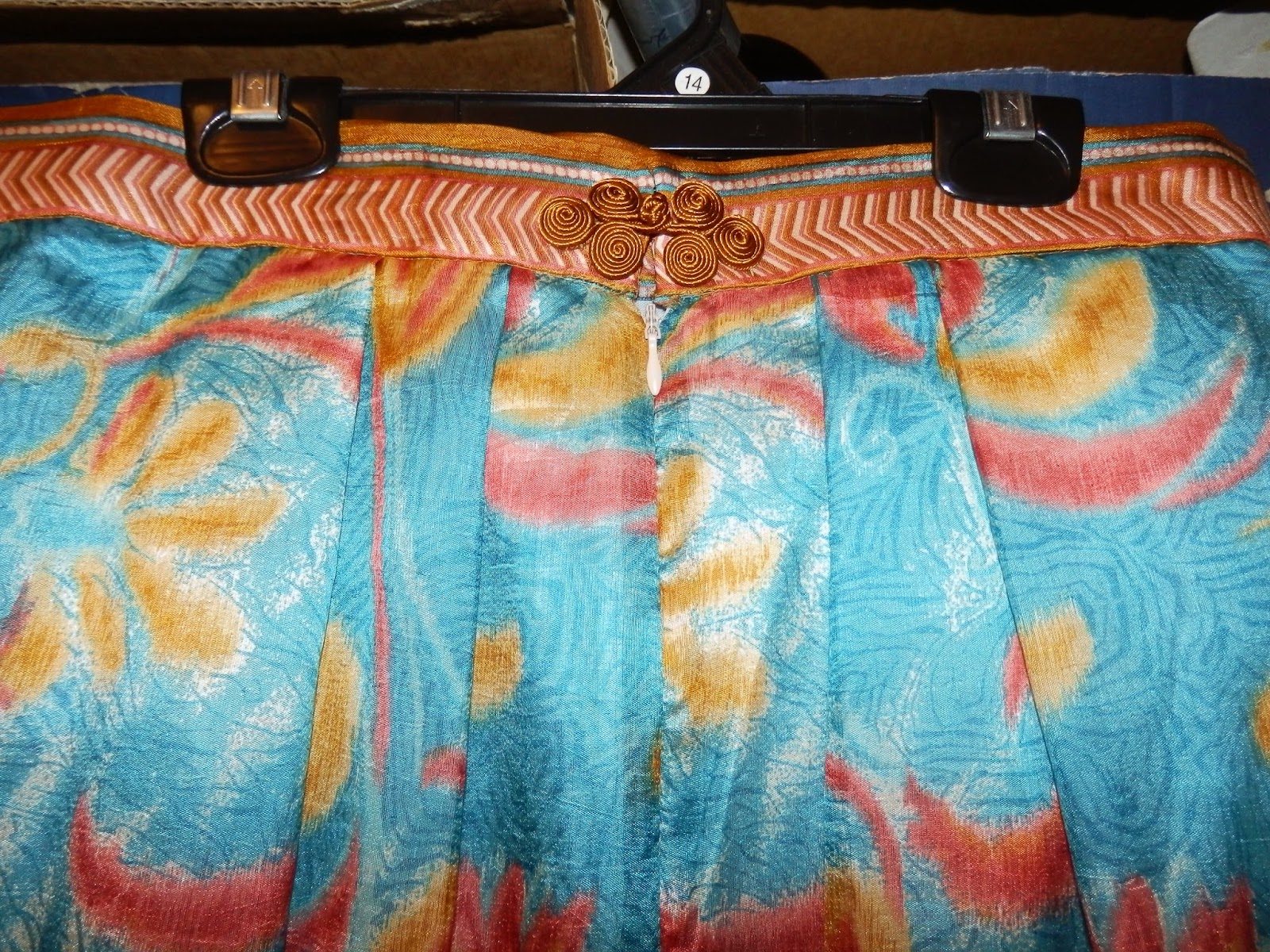
With Mum's machine chewing up the chiffon I wasn't going to risk it on the raw silk bodice I was working on. This was being made to accompany a full length skirt made from a length of sari silk. I'll admit I don't start with easy pieces. This one, my first major attempt at sewing (it began long before the dresses and skirts of this post) was inspired by an outfit belonging to Jackie Kennedy of all people. Despite the fact that her figure is vastly different from my own, it seemed, at the time, to be a good idea.

So I began folding the stiffer-than-anticipated silk and was not getting anywhere. It would pleat, but not in the way I wanted and definitely not creating a silhouette I was willing to wear. Practical enough to know that if I wasn't happy with it, regardless of the effort expended, I wouldn't wear it, it sat in a dark corner glowering at me for several months before I decided to pull all the pleating out and start the draping process again. Much better!


With the skirt utilising the pattern of the sari, the bodice was constructed from the different piece that forms the front fall when draped as a sari. I used one of the decorative borders  of the fabric to create the waist band and bodice straps, tying the two pieces together and providing a focal point for the back of the bodice.

As expected, the bodice isn't perfect as I'm still having difficulty finding a pattern or style that fits enough to meet my standards. But that will take practice and a little luck so I've no complaints at the moment.


Found on Etsy
Project Four: This one was made entirely on Mum's machine, but I'll admit is still unfinished as I haven't gotten around to adding the second of the hooks and eyes needed to close the back of the bodice. Window shopping on Etsy I stumbled upon a bodice/skirt fabric combination which in conjunction with a recently bought pattern, could provide a very nice way of using up two measures of rather dated fabric.


Somehow I seem unable to leave patterns alone and make them as is. In this particular case I shortened the zip and moved to cover only the waistband and skirt leaving the back of the bodice open, closed only by two sets of hooks and eyes. It made it easier to install the invisible zip, but I'm not sure how acrobatic I'll need to be to close the bodice up each time I wear it. And as it's not polite to show your bra strap, it may prove a slight dilemma (that hook and eye is the one that still needs to be installed... eventually).

The other alterations were not my fault. Provided zips are moved to the centre back, all waist bands and skirts are now relatively easy to make.
Saying that, I did add 2 inches to the length of the skirt. I seem to frequently forget that I'm taller than average.

Bodices however are still a bloody nightmare. In this instance I measured and cut the pattern and then discovered that it would have barely covered half my boobs. Given that an empire line is supposed to sit under the bust, not cut it in half, I found I needed to add 2 inches to the length of the bodice and even then it just worked.


This pattern also reinforced that pleats and big boobs don't really work. In the pattern diagram, the pleats are supposed to sit softly over the boobs producing a blouse-like appearance, not be pulled out of shape to draw attention to the armpits.
Perhaps 2 inches is not enough to add. Perhaps it just wasn't designed for anyone bigger than a C cup.

As a pattern that's annoying to assemble, and unflattering, it definitely doesn't win my favour, or live up to its branding of being a 'Vogue Easy Options' pattern.

Not a bodice pattern I will be using again soon.
Sorry Vogue.


The next projects have already begun...


Thursday, 31 July 2014

Coordinating the Past

As part of the process of cleaning out my grandfather's house, I have commandeered all of the old photos and am in the process of digitising them so that they are larger than 1 square inch and can be owned by everyone on the immediate (an possibly extended) family and printed and reprinted according to inclination or requirement.

What this has also allowed me to do is better connect the few dots I have of my grandparents lives and the early years of my Mother and aunt's lives. Through the enlargement and examination of old photos I could identify my grandmother's wedding dress in both incarnations and connect it with the dress hanging in my own wardrobe. And now there are more connections to make:

In my grandfather's wardrobe, only a small collection remains of my grandmother's clothes and some of her daughters' party dresses.

Late 1955/Early 1956

 
The dress, as worn by my mother now hangs safely in my wardrobe. It joins an ever increasing pile of old pretty dresses often hand sewn and decorated with ruffles or rows of lace. In an age where babies are so often dressed in cheap and/or heavy duty fabrics the delicate confections of my mother and aunt are too unusual not to keep for some imagined future wearer.


1960

My Aunt at an equally adorable age. Obviously baby portraits were the rage. The knitted dress was found crumpled in a plastic bag in the back of the wardrobe. It probably needs a soak and the ribbon an iron, but it's sweet. Just a pity the original owner's granddaughter is already too big for it.


1957
Violet in a sexy/summer dressing gown with Jocelyn, before the master bedroom's dressing table. The dressing gown and dressing table survive.  The former is made of a rough chiffon edged with black lace and discovered by my cousins in the bottom of a wardrobe along with a red corduroy dressing gown and a faded oriental one.


It's a dressing gown that I am not surprised to see. The reason is that it compliments the satin nighties and French knickers that were recently rediscovered and were presumably part of Violet's trousseau. In fact the one she is wearing under the dressing gown in the photo


1961 Family Photo

My sister and I acquired my mother's Sunday best years ago and unfortunately it has experienced some mistreatment since 1961. Surprisingly, it was worn only recently to a hat party. I cannot tell what the little girls are wearing and whether it has survived, but unfortunately I do not recognise the dress my grandmother is wearing.
What I do wish to know, is how many starched petticoats my mother is wearing under that micro-mini.


To go one better, Violet's hat has also survived, a thin cream number with a wisp of a veil.
From the story Granddad tells, it was the height of fashion and not cheap and, not appreciating Violet's desire for it, he offered to make her something similar by painting a piece of cardboard white and adding a touch of frou-frou to it. Violet was not impressed.
(The gloves may be the white leather mousquetaires/opera gloves from her wedding, in which case, they too have survived.)


1960. Peter's 1st Communion

This hat had matching green suede gloves, silk scarf (which has survived), shoes and bag.
What has also survived is a beautiful thin cotton dress with splashes of this bright green, orange and blue through it. It was probably worn under the heavy winter coat in the photo, as Violet was stylish enough to co-ordinate an outfit in an era where that was de rigeur.


1962 1st Communion party dresses

The blue dress has survived, faded and almost in two pieces, but it can be easily restored should a granddaughter look as adorable in it as her grandmother did 50 years ago.

The pink dress is still in one piece - just. It's delightfully shiny with matt pink ribbon gathered and attached to all possible surfaces. Unfortunately while the fabric has survived, the thread has not, converting seams into gaping holes and revealing slits.
The headdress, a row of fake flowers, worn originally with the mini bridal gown associated with 1st Communions also exists and is safely stored with the veil, poof bag and white gown.


1963 Family Outing

Taken in the year before Violet died, this was a family outing to see the Canning Dam overflow. Though its difficult to tell in this image due to the deterioration of the image's colours (on the original slide the blue is definitely blue), Violet is wearing the blue polka dot shift modelled on the left.

None of the bows are known to have survived.

1970

Possibly a wedding, possibly just a nice dinner. It is a pity the pretty buttons were not visible at the minidress's original outing. 
I have worn this myself and can confirm that it is definitely a mini dress that could have doubled as a light coat. 

There are still plenty of photos to scan in, so here's hoping I can make more connections between them and the pieces we still own. 


Related Posts Plugin for WordPress, Blogger...