Wednesday, 30 January 2013

Blue Cheese Custard

I have a dreadful tendency not to buy cookbooks, but to flick through them commenting on the recipes and their supposed lack of originality. However the other day I did stumble upon one (a recipe) that sounded peculiar enough to warrant a try: Blue-cheese Custard. 

The recipe sounded unusual but exhilarating and after searching around for a suitable recipe (I failed to get a shot of the recipe in the bookstore and wanted an alternative without gelatine as a necessary ingredient) it was scheduled for a trial run for a quiet dinner with Mum.

The recipe was simple, but with such a strong blue and so much cream it felt unnecessarily decadent and left you concerned about your elevated cholesterol levels. So here is a slightly altered version, adapted from a guaranteed Creme Brulee recipe.

Makes 8.
Ingredients:
500ml (2C) milk
185ml (¾C) whipping cream
70g strong crumbly blue cheese
cracked pepper
4 egg yolks
1 egg

  1. Preheat oven to 160 degrees Celsius.
  2. Combine cream with milk and blue cheese in a saucepan and bring to boiling point over medium heat and turn off. (Do not boil).
  3. Beat the egg and the egg yolks in a bowl with pepper. Whisk until well combined.
  4. Slowly drizzle milk mixture into eggs while whisking.
  5. Strain the mixture as you divide it between the ramekins. this will remove any components of cooked egg.
  6. Place ramekins in a baking dish and place boiling water around ramekins up to half way. Bake in oven for 35-40 minutes or until set. Remove from oven and allow to cool slightly.
  7. Serve with a salad of ingredients that compliment the flavour of blue cheese: roast pumpkin, walnuts, rocket, prosciutto - lightly fried till crispy, pear, broccoli...

It was so delicious I forgot to take a picture before we commenced eating.

Sunday, 27 January 2013

Commissioning Cupcakes

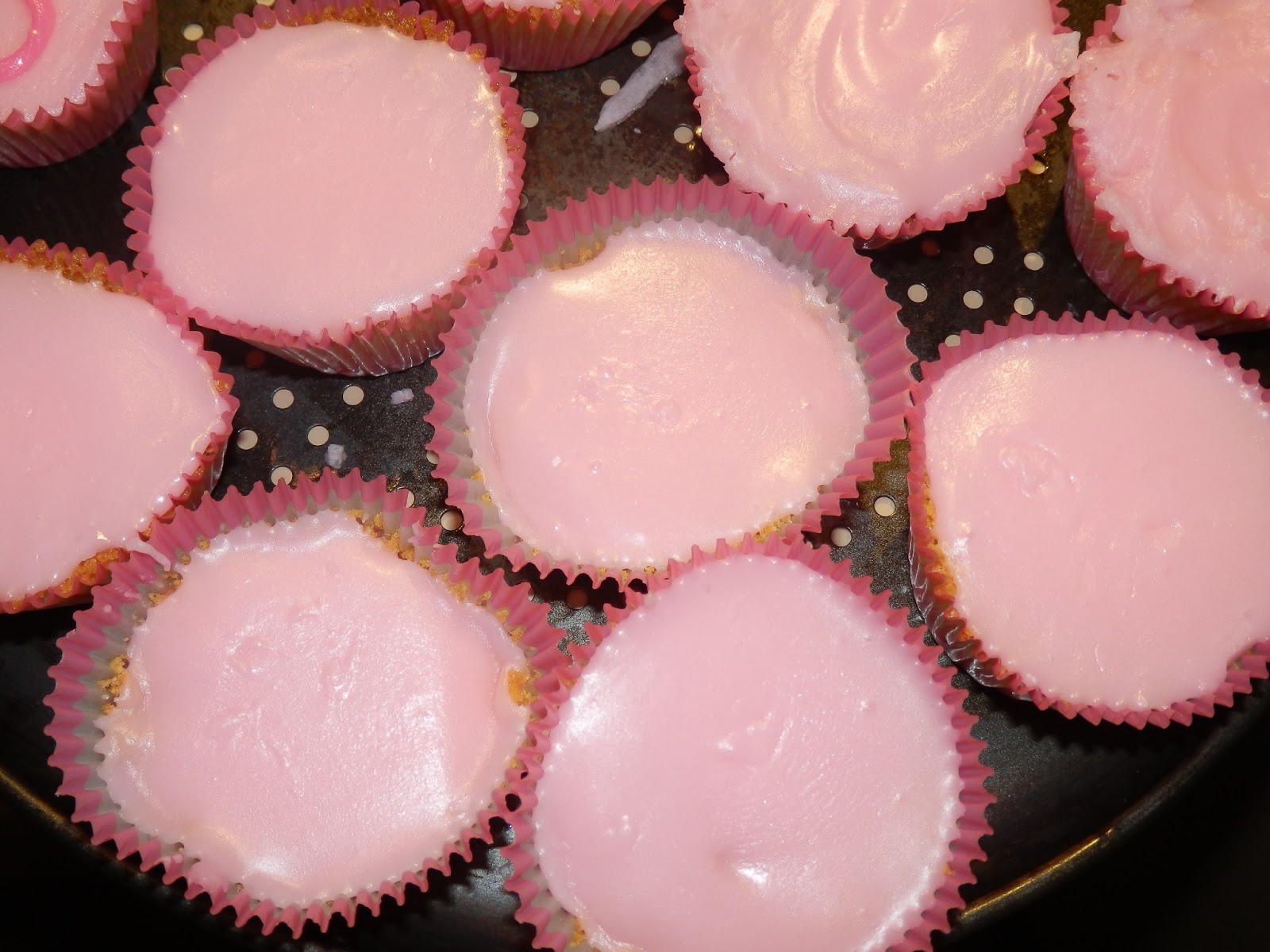
My cousin just turned one, and so, as a part of the celebrations for her granddaughter, my Aunt commissioned me to make 24 pink cupcakes with pink icing.


Now the cupcakes were easy, but I'm not very experienced with icing: I substitute in chocolate whatever the occasion. But you can't really do pink chocolate (white chocolate is NOT chocolate). So it took a little bit of trial and error and luck to get the icing to do what I wanted as opposed to what it wanted. But they finally worked, and I had little rows of pink cupcakes in pink patty-cans lining the kitchen bench.


Now having gone this far, it seemed ridiculous to waste the remaining icing and so as an added gesture (that I'd beaten the icing into submission) I decided they needed decorating... with more pink.


Next year, I'm doing green, or orange, or yellow, or chocolate...

 ...not Pink!

Super Easy Cupcakes
2 eggs
Self Raising Flour
Caster Sugar
Soft Margarine/Butter

Weigh the two eggs. You will need the same weight of Flour, Sugar and Margarine.
Cream together the butter and the sugar until creamy and fluffy.
Fold in the whisked eggs and flour bit by bit.
Spoon mixture into patty cans so they're half filled
Bake at 180°C for 15 minutes
Decorate as you see fit.

Tuesday, 22 January 2013

Writing Monologues - My First Attempt

Setting: St Matthew’s Church, Guildford. 1920. The church is filled with mourners (the audience) who sit in silent reverie, for they are participating in the funeral of Mrs Augusta Wentworth. Augusta is also there, but clearly not one of the congregation as she is dressed with her usual flair in a slightly dated gown of a golden yellow, and is wandering around the church. She is aware that it is her own funeral and is providing social commentary as was her habit in life.

Augusta Wentworth is a fictional pioneering member of the Guildford community. She and her husband Thomas arrived in 1860 with their two sons and settled on the upper Swan, north of Guildford which remained their local township. Though she had a rather privileged upbringing in England, like many women in her situation, she experienced hardship in the new Perth colony. As she grew older she became one of the personalities of the area and was renowned for her vibrancy and energy, particularly amongst the younger generations.

Augusta:    We’re here are we? I suppose it’s to be expected. There aren’t any other C of E churches in Guildford.
It’s just, I’ve attended enough funerals here without this one. Thomas was first. That was almost thirty years ago now. It is strange how it still feels as though it were yesterday. The doctor said I was lucky to have him that long, but that was why we moved to Australia: so he would live longer. So we could share a full life together. He was only 65. I suppose I just didn’t expect to reach 87. At least, not without him. Truthfully, I’m surprised I lasted this long. This pioneering lifestyle should have exhausted me years ago. Remember, there wasn’t much here when we arrived. Unless it was the pioneering spirit that kept me battling on. And if my Thomas wasn’t enough, we had to repeat it all again five years later burying James and his family. A mother is not supposed to bury her son! Particularly not when he’s accompanied by his wife and daughter. Such an unexpected tragedy. Poor Lucy. I made sure her flowers were pink, her favourite. It was the least I could do.
(She stops, listening.)
Oh dear, they do drone on don’t they. I don’t see why, as they all know my life story: I’ve told enough of them. And those I didn’t tell, gossip reached anyhow. It had a way of doing that in this community. I suppose they are family though and I was allowed such outpourings of pride and grief at Thomas’.  Ned always has been such a wonderful speaker. As grandparents we’re not supposed to have favourites, but he was always mine. He is just so like his grandfather. And when he married Miss Eliza it was a dream come true. They do suit each other so well don’t you think? I remember when she and her sisters first arrived here. Three young ladies all in grey quietly seating in their family pew: they caused quite a stir, and not just on that first Sunday. Until their arrival there were never enough visual distractions from the monotony of the sermon. These walls are unadorned and the windows basic enough: too long and thin though. Less enlightening than they should have been for a church, in my eyes. And I don’t know why I never contributed towards replacing that alter screen. At least they were thoughtful enough to decorate it with flowers today.  Mimosa always was my favourite: the little downy balls of sunshine brightened the hardest of days, then and still now. I gather the [reverend] hasn’t changed though. (A dear little man, so kind and well meaning, but heavens he knew how to put his congregation to sleep.) (she turns to face the altar) Good heavens, he has.  Poor Canon Everingham must not be with us any longer, he was old even then.
(By now Augusta is at the other end of the church near the door where she can survey the church and the congregation in their entirety.)
It really is a drab little church isn’t it. I don’t know why I never considered being more vocal when it was being built. Anything to liven it up really! Well, not that! (She’s just caught sight of the World War I memorial.) I’m thankful our name is not included. That would have been a tragedy too terrible to bear. We did our part though: here, as far away from the action as possible.  Jack so desperately wanted to go, but he contributed to the cause in a far better way and without the needless shedding of more blood.  (My cousin died in the Crimean.)They weren’t all so fortunate though. Poor Miss Mary-Anne. I hope she bounces back as it’s too quiet around here without her laughter.

(She softens as she catches sight of the font.)I suppose this church does have some happy memories too. Several christenings, a few pretty weddings… (she laughs) John screamed the church down when he was christened. He certainly inherited his father’s lungs. (she pauses to recollect). That wasn’t John. That was Anthony (God bless his soul). The Reverend christened him one week and they buried him the next. He never had a chance at life. His brother married here though: Mr John Wentworth to Miss Kate Townsend. Such a beautiful wedding; Mrs Townsend made sure of that. The bride, with her golden halo and strawberries and cream complexion, was a vision in white tulle and pink roses.  (I do sound like the society pages.) Her sisters less so: delicate pink just didn’t suit Miss Eliza’s complexion or Miss Mary Anne’s style.  I remember it well: I had to lend Mrs Townsend my handkerchief as she’d wet her’s through. 
Her second daughter was never so conventional though: Eliza and Ned bypassed this church for a quieter one down south. Very intimate from what I’ve heard: just what they wanted. It wouldn’t surprise me if they planned it all along. They were clever like that. I’m not supposed to know, but so long as you don’t tell Mrs Townsend… she’d never forgive her daughter if news of the elopement reached her. Not after all of the effort she put into arranging that wedding. You can’t blame them though: two spirited children and a very determined mother of the bride? I probably would have done the same. In fact I know I would have.
(she takes a seat near the altar)
Heavens! I’d forgotten how airless it gets in here. These summer services always were the worst. And yet we never adapted to the climate. A service at sundown would have been far more sensible. I think Miss Mary Anne queried wearing her swimming costume to church one year. It really would have been a sensible idea, if her mother had allowed it. Then again, I’m not entirely sure how the rest of us would have reacted. But of anyone, Mary Anne could have pulled it off. Is it me or is it getting hotter in here? (She pulls out a fan and starts fanning herself) Surely they can’t be much longer. Here, sit beside me and rest. We’ll wait until they’ve all gone. It won’t be long now.

Friday, 18 January 2013

You need only step outside.

I will admit, I live in a paradise.

A slightly tamed garden of Eden where the wildebeests are tamed and the birds, and frogs, and insects run riot in a myriad of colour.

To see the beauty of nature, I need go no further than my side door where a sacred Ibis patrols the patio digging up grubs whilst supplementing his diet with the mosquito larvae and frog larvae that populate the lily ponds scattered in amongst the trees and undergrowth.


He is such a regular guest in this banquet of a garden that he has been endowed with a name: Igliot (with a silent 'g'). He's delightfully unperturbed by the presence of two cats, instead insisting upon introducing his friends to such a gem of a restaurant. 

Under a Golden Shower Tree a speck of vivid blue flits between shrubs. In the eye of the beholder it contrasts superbly with the decaying leaf-litter below. When at last it cares to alight upon a reed it's seen to be a Damsel Fly, its tail dipped in paint, and its lace wings carefully folded up above its body.


At the corner of the herb garden, the physalis has fruited, each one infused with a bust of flavour which ensures it never reaches the kitchen table.


Now, the empty husks gather at its roots while in its velvety leaves oil-winged insects perch waiting for the end of the summer shower. 


Nearby the sage is flourishing and full of growth. It seems to be a favoured resting place of one of the many dragonflies that call this plot their home.


Beyond in the pepper tree a family of rainbow lorikeets swing upside down amongst the fresh berries, each one eager to tell the family all about it's day. A noisier bunch you never did see but they eat their fill before winging off across the park, their shrill chatter fading into the blue sky.


The soaring summer heat has brought the bees to rest upon the water's edge, delicately tiptoeing across the pond weed to quench their thirst in the murky waters below. They trickle in for a quick dip, much as Italians do a caffeine fix, before returning to the far more fragrant portions of this suburban paradise.


By another lily-pond a powder blue dragonfly tests his wings. He's old and battered, his fraying wings showing signs of wear and tear.


From the timid rustle in the peach tree, a wattle bird emerges disappointed at having found no fruit, before flying off to the safety of the corrugated fence.

By the driveway, a pincushion protea compensates for the loss of the pincushion hakea, it's brilliant orange orbs contrasting against the green foliage and pale brickwork of the boundary fence.


The driveway is proving home to at least one other creature: a daring red, this dragonfly is hard to miss as it dances its way across the tessellated pavement. He's far more timid than most and lightly hops from tile to tile until your breathless anticipation causes him to cease and hold his pose. Then off again he flies, another slash of colour against the bright blue sky.


On the wooden bench, once cowered into submission and now oblivious to it all, the cat lies, heartily hoping everyone will believe her pretence at sleep and leave her to sunbathe in peace. While in the distance, a kookaburra, silhouetted against the fading sky, laughs with delight.


Sunday, 6 January 2013

For the Possums to read.

At this time of year the possums must be loving it: a chance to bone up on their reading before the festive season ends.

After all, that is what the fairy lights in the trees are for... isn't it?

Tuesday, 1 January 2013

Fireworks

I am used to love Perth fireworks, the heat of a summer's night ending in a cacophony of sound and light as the city treats its inhabitants to the spectacular show that is Australia Day. And yet what I still miss each time I see fireworks now is the feeling from watching my first London fireworks on Guy Fawkes night more than two years ago.


By November London is rapidly cooling down for whatever warmth they had achieved over summer. The air is nippy and the ground chilled, verging on the frozen. And yet standing on Blackheath awaiting the fireworks, something was different. At home the fireworks are launched from the middle of the river (it's the safest place really when so much of the surrounding land is covered in dry grass, twigs, leaves that have a tendency to ignite at the mere thought of it) so seated on the water's edge you're some distance from the fireworks.


What I loved about the fireworks on Blackheath was that you were automatically so close to the action. The fireworks were launched 50 yards away and exploded  directly above you, and as each one slowly died, the ash and residual embers descended all around you. With the explosion in your ears, you actually felt a part of it, as opposed to just a spectator.


This year it felt a little like London. It was misting all evening and combined with a slight breeze I was wrapped up in goosebumps inside the encompassing fold of a shawl. Somehow that feels more like it. 

Sunday, 30 December 2012

Sand and Surf

We spent today at Naval Base, the little village of holiday homes where my Mother's family owns a few of the shacks that grace the cliff face of the Indian Ocean. In the current chain of days registering 40+ on the thermometer, it was a welcome respite, a chance to dip into the refreshing sea water before momentarily sunbathing in the heat of the midday sun.


Where Granddad's shack is, there is a tiny beach: a pocketful of sand hemmed in on one side by the rocky limestone cliffs and on the other by the pale aqua blue water rippling in the sunlight. For our first swim the water is calm and clear, quietly lapping at the golden sands allowing us to drift along following the striped fish and they darted in and out of the rocky outcrop below.

But midday a north-westerly breeze had hit, capping the growing waves and gently rocking us in the direction of the rocky shore. It then died down again, returning to a state of clear tranquillity and warmth, and tempted we submerged ourselves again, washing off the residual cobwebs of heat and sweat and stress.


Floating in the shallows, I remember a time, years ago, when as little girls my sister and I would float out to a rock ten metres from the shore and peering down through a glass-bottomed bucket, we would examine the sea grapes and mussels with which the rock abounded. It was from this selection that we would collect a sample to examine further at lunch. In addition to the fresh mussels, Naval Base brings with it memories of fresh crab, being taught to use the dead crab's claw to ferret out the tender flesh from the depths of the jointed legs. On one occasion a sea urchin was found, its life ending on the barbecue as like the mussels, it's shell was cracked open and content drained in high appreciation.

On occasion we would stay till dusk, watching rays play in the shallows, watching the sea breeze creep in, and the sea swell to a crescendo with the gradual setting of the sun.


Friday, 28 December 2012

What is love?

What is it about us?
Do we have such unrealistic expectations of love that we're never satisfied?
Have we come to view the romance of being in love as the only type of love? As the thing we should expect to feel for someone for the entire of our lives? As though the absence of this is the absence of love, period?
Have we ceased to identify the different concepts of love, focussing solely on the intoxication of being in love because that is the idealistic fluff that is perpetrated to us through the mediums of society? This bliss of first falling in love is what we expect to perpetrate through the 'happily ever after' fairy tales have promised us?

I remember a sermon at school where we were introduced to the Ancient Greek classifications of love, for where we have one word which sprouts confusion, they have at least four: agape, eros, philia and storge. Unlike us, they differentiate between the dutiful love of children towards their parents, or the love that exists between friends. They also differentiate between the passionate sensual type, or being in love and the deeper sense of true love. And it is this last word, agape that is used to express 'I love you (s'agapo)', a phrase that even in this language should outlive the honeymoon period.

While the feeling of eros, of passionate sensual love, be it sexual or not, is an intoxication of which we can never get enough, we have ceased to listen to the voice of experience that warns us of eros' short life span. It is the honeymoon period before real life sets in, when our eyes are opened to the faults of the other and life's little stresses get in the way. When the addition of new responsibilities impact upon the dynamics of a relationship. When the mundaneness of raising children and maintaining a household become the focus of each lover's world and their passionate love for each other morphs into a steadier love.

Growing up, we are subconsciously indoctrinated by the fairy tales and Disney stories upon which we are fed. Though they teach us reading and comprehension they also provide lessons in social expectations: the type of women of the world, the importance of beauty, the 'happily ever after' of falling in love and marrying Price Charming. In this day and age, this is unrealistic and unacceptable. And yet novels exist that can prepare us for life. Romances even, that override the kitsch that Disney has to offer, that can explain this difference in love about which we appear to have become so oblivious. Just one example is Georgette Heyer's 'A Civil Contract' where the young hero is torn between the woman he is in love with but could not marry and the woman with whom he entered a marriage of convenience but eventually comes to genuinely love. Not only does it show that relationships need work to thrive and overcome hurdles, but also the potential unsuitability of in love love to the hardships and business of day-to-day life.
As an exercise in realism, this is a far better thing upon which to base your expectations than the fairy tales and Disney stories upon which we are expected now to grow up.

Wednesday, 26 December 2012

Nativity Scene

Every Christmas (bar this one just gone) my grandfather would construct in his sun room a mountainside nativity scene out of waxed butchers paper. It was a tradition his father had passed on to him, though as the years advanced Granddad would comment on the difficulty in finding the specific type of paper he required to achieve his vision. It was always absolutely stunning, a rocky outcrop around a central cave in which the holy family sheltered but every year it was subtly different, depending upon the creases of the stiff butcher's paper. In the foreground the shepherds tended to their flocks while on the hill behind modern wooden houses and little ceramic churches dotted the landscape. Granddad loved playing with things, electricity included, and so he'd wire up the houses on the mountain side with a set of Christmas lights, however he'd always include one setting for us which we were told was of a naughty boy playing with the light switches in his house.


During the festive season, our first port of call when visiting Granddad was the nativity scene where we would scour the nooks and crannies for the hidden baby Jesus and then proceed to hide him again so that come Christmas Eve, only we knew his location and only we could place him in the manger. Between the cousins we'd team up against each other, and try to be as inventive as possible so that no one else was able to find the hidden baby.

Wandering through Naples earlier in the year, we stumbled upon a Christmas market that specialised in the type of tiny figurines that graced Granddad's set. Every ornament was beautifully executed, from the tradition shepherd carrying a lamb across his shoulders to the more exotic boxes of Asian vegetables designed to grace the local market stalls of the village scenes and with every one I was reminded of Granddad, if not because it was so like what he already possessed then because it was something unusual that would add so much to his carefully maintained traditions.

As we wandered through, I was on the look out for a small cat, a personal symbol to add to the nativity. Cats have played an extensive role on our lives, my Grandfather's included but they are one of the few animals excluded from the stables, and the bible as a whole. Despite being such an appropriate inclusion, I was hoping to teasingly provoke my Grandfather's reaction of 'it goes against tradition', particularly as being a good Catholic, he would be bound to know of the poor cat's absence from the bible.

My argument in retaliation would simply have been that it was adding to tradition, something I seem to do with all the traditions he passes down to me.

I didn't find one.

Monday, 24 December 2012

My (cousin's) first...

My cousin (technically first cousin once removed) is 11 months old and Christmas Eve marked her first visit to Kings Park, our botanical gardens overlooking the Swan river and city of Perth. Kings Park is beautiful: in On the steep slope down to the river native flora grow wild while above manicured lawns festooned with gardens of natives provide the perfect locale for family picnics and weddings.


Picnicing near a young tree, my cousin decided that now was the perfect time to indulge in a little exploring, particularly of the black dirt in which the sapling stood. With no restraints and little more than a mild protest from her mother, my cousin liberally covered her feet, legs and hands in good clean dirt. Watching such indulgence was a simple classic image that could have dated from anyone's childhood and reminded me of photos of my own sister: I recollect a photo of her from before she was walking crawling across the grass with her mouth covered in dirt and grass and if anything, its just given her a more detailed interest in plant life.


King's Park is delightful for not only does it possess and array of plants native to this area, but it also contains varieties of English trees that herald back to a time when we were still only a British outpost actively tried to recreate the English landscape many settlers missed from home. Wanting my cousin to experience as little more of the park, I kidnapped her from the party and went for a wander showing her some of the different plants and introducing her to some of the sounds and textures of the park. I felt as though I was introducing her to the smooth bark of a eucalyptus, the metal plaque of a war memorial, the crunchiness of the flowers of the everlasting (paper-daisy) and the stiff velvety leaves of a banksia.


It was an utter joy discovering such natural things with her and seeing her follow my example and touch things or just sit there with a smile, taking in the thinks I was pointing out to her: the magpie having a standoff with a crow, the pavilion in which her Nanna married... I know she's too young to remember any of this but I suppose I want her to have the opportunity to have as rich a life as I do but with the type of richness I feel to be most important.


Related Posts Plugin for WordPress, Blogger...