Saturday, 23 July 2011

Modern _Art

I hate modern art.

I really do. I see no purpose or beauty in its presence. Too often its crude, unimaginative, untalented and unworthy of the controversy it provokes.

And yet a recent trip to the Tate Modern did wonders for my soul. I went with C, a beautiful soul who, though a little blonde, is always willing to learn, and unfortunately willing to believe anything seemingly intellectual that utters from my mouth.

We puttered. After all one really cannot leave the Tate off one's tourist list of places to go, and we had time to spare. Given our inclination towards modern art we did well. We examined the main floor, identified all the important artists and exchanged our personal thoughts on the pieces at hand.

What I also did was break each piece down symbolically, creatively, historically. As we wandered through I explained the artist's motive, the vision, the purpose of each piece. By now, C was used to it. She was used to her own private audio guide regardless of the palace or museum we entered. And so she absorbed every morsel that I fed her, nodding happily as I made each piece that little bit more accessible. All of the bullshit I mockingly spouted.
Not at her.  To her.

Strange thing, it took her several months to realise. For me to tell her again that I hadn't known what I was talking about. That I'd make it all up as I went along.

Her response: I'd made it all make sense. 

Friday, 8 July 2011

Brighton Rocks

It being the middle of Summer, we decided a trip to the seaside was in order, and with half price tickets to Brighton, it seemed the place to go.

The Brighton Clock Tower, erected in 1888 and depicting the long dead Prince Consort. 

Sunday, 19 June 2011

Lost in the Long Grass

Waiting in Kensington gardens for a friend who was running late, I stumbled upon a stone marker in the ground covered on two sides with a strange series of letters and numbers.


Curious as to its presence but with nothing to indicate its function, I took a couple of pictures before forgetting about it completely.


That was until something similar popped up on an old Time Team episode and I remembered my photos and began to wonder whether what I had stumbled upon was an old parish boundary marker. It had been situated in the grass just off one of the main paths, in line with the boundary perimeter of the St Matthew Bayswater Parish within the larger, older Paddington Parish.


Were the numbers beneath each set of initials the date of the Parish's founding, the date of the definition of the boundary? Were they still representative of boundary lines or nostalgic remnants from bygone years?

Sunday, 5 June 2011

Eltham Palace

Hidden on the outskirts of South-East London is Eltham Palace.

Once the abode of medieval kings and a childhood home of Henry VIII, it now contains little more than a snapshot of this history, the majority of its essence being devoted to the elegance of  the Art Deco designs
implemented whilst under the private ownership of the Courtaulds.

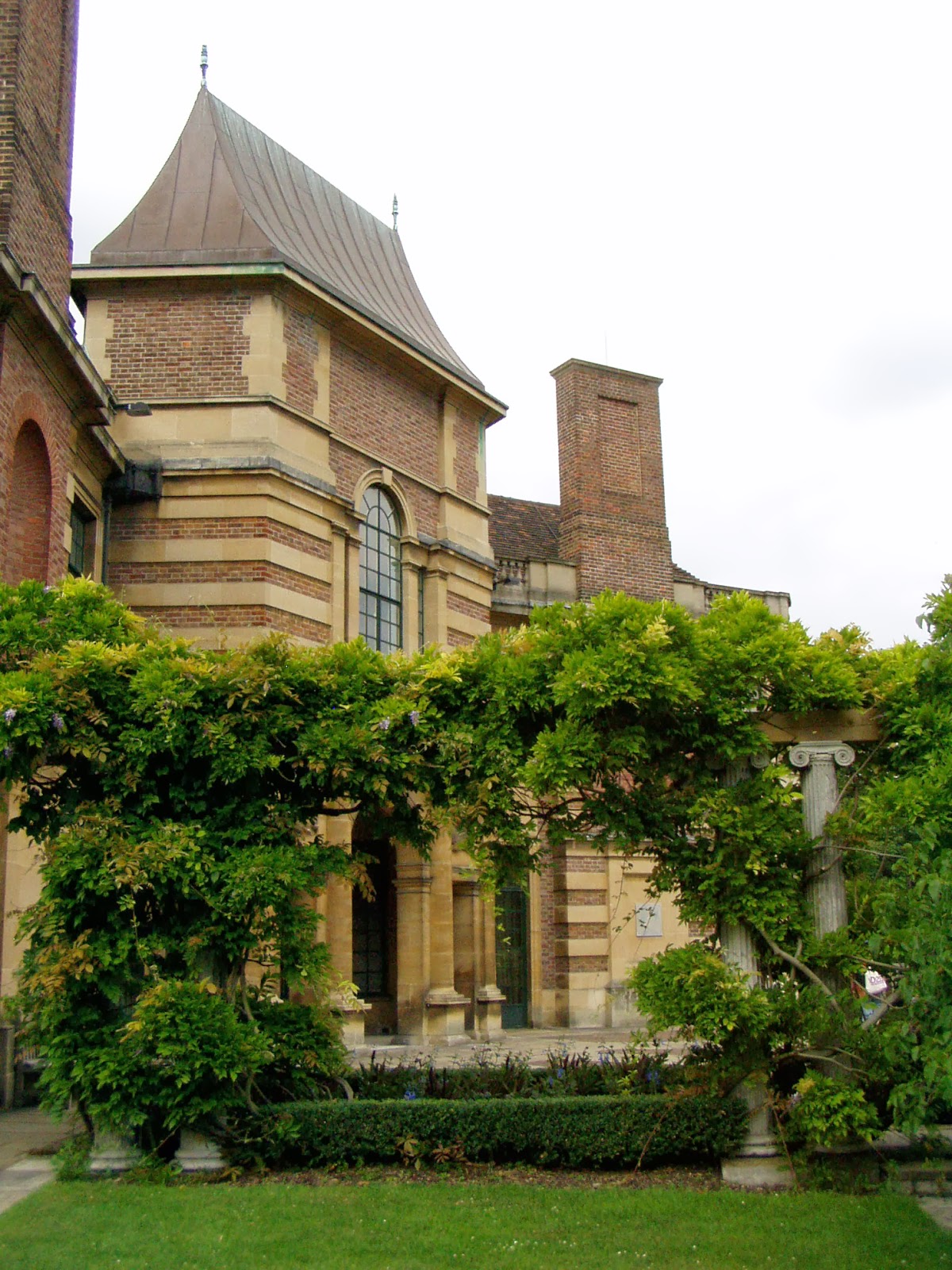
From the entrance gate, Eltham Palace looks like one of your normal historical private residences; it has the gate house, the winding driveway through picturesque gardens, a colonnaded entrance and several wings.

However as you cross the moat and turn into the forecourt it becomes apparent that one of the wings is unlike the rest of the building; its lower half is buttressed while the upper is pierced with the delicately decorated arch windows typical of medieval times. This is a building far older than its surrounds, a realisation that if you left yourself time to think would have you wondering what it was you had chosen to stumble upon. Of the main structure of the house, though decorated with the classical pillars, and the terracing and paned windows of a Georgian building, there is still something decidedly recent about it.


However it perhaps isn't until you step inside that you begin to realise why. The Entrance Hall / Living Room is the largest room in the house, filling the spherical triangle between the two wings.
By historical standards it is sparsely furnished, but each piece has been chosen specifically and set upon an original rug placed beneath the pricked central skylight. Flanking either side of the door through which you entered, are marquetry panels of Italy and Scandinavia, guarded by a corresponding depiction of a Roman Legionary and Viking.


Aside from the drawing room, which has been furnished in a somewhat Florentine Renaissance style with visible ceiling beams, ornate wood carvings and  stone alcoves, the remainder of the house has been furnished is a sumptuous Art Deco style befitting the wealth and social position of the Courtaulds. Many of the rooms have been panelled in warm woods and furnished in a minimalist but comfortable style, often inclusive of built-in furniture. 


Aside from the local map embossed into the panelling in Stephen Courtauld's library, perhaps the most impressive room is that of Virginia's bedroom suite. Carved out of a rectangular room, the bed rests against a semicircle of warm wooden panelling through which doors lead to her husband's suite, the wardrobe and a rather ornate bathroom. 


In the marble lined bathroom, Virginia's bath sits within a gold mosaic niche and comes complete with gold plated taps and lion's-head spout.


Surrounding that house is a strange composite of floral and kitchen gardens interspersed with Grecian columns, and the remnants of the medieval moat and bridge. At the front of the house this has retained the appearance of a moat. 


 But as you travel around the garden the moat ceases, and reappears as a lily pond before disappearing altogether to be replaced with a grassy park stretching under another bridge before continuing round to connect with the start of the original moat. 


Wandering through it in spring, the vibrant flowers and bright green grass eagerly take the place of the swirling waters of the moat providing a place for families to picnic and tourists of all ages to rest a while and enjoy the rarity of a bright spring day.


In the warm air the bumble bees clamour over the heads of lavender making the utmost of what little time they have. They are in a drunken frenzy, making it next to impossible to capture their beautiful antics on film.


Originally a Tudor Castle, the only surviving structure (aside from a few ruins in the garden) is the Great Hall, complete with minstrel's gallery and vaulted ceiling. 


And it is in the antechamber of this hall that the Courtauld's pet lemur Mah-jongg is depicted for prosperity.


Mah-jongg was a prominent member of the family, with a centrally heated cage upstairs and his own ladder leading downstairs into the flower room.


Monday, 28 June 2010

The Way Home

Cross the highway and follow the uneven footpath down among the houses. To your left a pillar stands where right upon a cat is perched, waiting as the evening's welcome party. As it arches its back to receive a friendly pat the dog next door responds with overtures of jealousy. Do not falter in your steps, but progress further down the path, leaving the roar of the fast-paced city behind. It dies slowly and is replaced by the melody of the evening's feathered friends heralding the dying of the day. Where the family of wattle-birds squabble over a golden hibiscus turn from the footpath and continue on into the unkempt grass that brushes against your bare legs. Ahead two ducks share a meal while in the distance a sacred ibis feasts alone. They remain at peace if poised for flight, but will keep a wary eye until you pass. The giant tree has lived its day, and hollowed out remains a sceptre of its past, but not devoid of life. Widely skirt the lifeless boughs that hum and buzz as bees swarm by. They cause no harm but fill the air with soothing sound, and promise better things to come. The pink and grey galahs across the way are busy too: they're mounting guard and have two new mouths to feed. A yearling magpie runs across your path, crying for its mother, though she’s only paces away, foraging for food amongst the leaf litter and bark. As dusk falls a new chorus joins in: taking advantage of the cool air the frogs emerge and singing from the growing shadows, welcome you home.


Tuesday, 20 October 2009

Dear Researcher...


Dear Researcher,
Please allow me to describe a creature to you, a machine designed to do your bidding; Programmed to obey your every demand without rebuttal or a murmur of complaint. It is a classic model, cased in burnished metal that glistens under the fluorescent lights of your office. This skin is tough enough to withstand the barrage of shots hurtled its way, suffering at most, a microscopic dent.  And it is flawed enough to avoid reflecting back the treatment to which it has become subject. She, for that is her appearance, has the appearance of being forever ignorant of the abuse and accusations with which you so liberally tarnish her, but you only see one setting. You’re only greeted with the smiles and politeness that go hand-in-hand with the tasks she performs. You cannot see the endeavours to avoid retaliation or simply ignore the task at hand. Or note the well-shod feet that tiptoe by so careful not to offend. You may deny it, but this creature is intelligent, ne’er surviving if this were not the case. She knows when not to speak, and hold her tongue, when to teach, and when it’s simpler to complete the task herself on your behalf. Her work is not to benefit herself, but aims to ease your load and simplify your job. And when her job is done, you think nothing more of packing her away and returning her to the dingy office where silently she waits again to do your bidding. Please allow me to describe a woman, to you an admin assistant.
Kind Regards, 

Saturday, 17 January 2009

Mastering Macarons - Attempt One

Travelling around France in 2008 I bought a macaron cookbook.
Two actually. 
Both full of pictures, both full of delicious recipes, both in French. 
But I bought them none the less, because I loved the macarons I'd been sampling throughout France and because I wanted to be able to continue sampling these amazing desserts when I went home, to a city where macarons were mistaken for macaroons.


Then in 2009, before Perth acquired an obsession with these French desserts and before everyone wanted to learn to make them, we took up the challenge, Claire Madeleine and I. As I have since learnt, macarons are difficult to make regardless, but on this occasion, we were cooking from a French recipe, with only Google to translate it for us. We followed the recipe to the letter, though it would have been easier if each of us had been a multi-armed Hindu goddess in our manipulation of the spatula, mixture, mixing bowl and piping bag. Somehow we managed, with the oven soon filled with trays of promising macarons.


They were passable. In the oven they looked pretty enough, but the cooking time wasn't nearly enough resulting in sticky collapsed rounds that needed to be prised off the baking paper.

However, with a liberal scoop of chocolate icecream, or dollop of lemon curd they tasted delicious, and with careful positioning could be made to look delectable... in a rustic sense.

Sunday, 16 March 2008

Galatea


Even before her descent from the marble pedestal Galatea was beautiful. Her features had been sculpted in the likeness of Aphrodite: fairest of all, and while Athene had breathed life into her, she had been blessed by the Graces and had the Muses Clio and Polyhymnia  bestow upon her their passions. And yet man, be he king, sculptor or lowly scribe is never satisfied, and though presented with his heart’s desire, the embodiment of a goddess, Pygmalion began to find faults in this woman; Faults he couldn’t believe had been present in his statue. He knew that like his creation this woman was delightful to behold, but he wouldn’t admit it to the world.  Instead he preferred to display an affectation of modesty all the while drawing his own eye to the ever-so-subtle changes between the living, breathing woman before him and his nostalgic remembrances of the cold forbidding statue he had spent so many months in creating.

The statuesque Galatea was no longer what he wanted: he saw her as flawed. Pygmalion wanted his dream, his statue, his goddess back. He wanted back the smooth and perfectly poised figure who remained with him always and steadily gazed at him through unblinking eyes. She, who was moulded to his beliefs, his desires, and his interpretations of beauty and her sex. But lightening does not strike twice in the same place, and so the blessings of the Gods are not again bestowed on those who sneered at the initial gift. Galatea, by all means as divine as men chose to call her, was indeed no match for a mere mortal; She could returned to her infinitely more appreciative sisters who graced Mount Olympus and the paradise of Mt Parnassus. As for the sculptor, well… his pedestal remained forever empty, for where a gift from the Gods is but shunned, no mere mortal can ever hope to succeed. 

Wednesday, 27 February 2008

Ad Nauseum


Glancing at the clock, the girl groaned inwardly and rolled onto her side. It was 3 am and the dull pain in her stomach was keeping her awake another night. It was a feeling she remembered too well: the introduction of a violent illness that had plagued her three months earlier and ruined her last days in Prague. She didn’t mind the aching nausea so much as the symptoms that had already visited her once today. She rolled over and glanced at the clock again. This time it read 03:04, causing another groan to escape into the room. This time it was as much one of inconvenience: in the morning she was supposed to catch a train to Frankfurt to make the flight home. Under ordinary circumstances, she would have felt exhilarated, and probably even enjoyed the nine hour trip north, but her rapidly approaching symptoms rendered this somewhat doubtable this time round.
Feeling her stomach knot, she slipped out of bed taking extra care not to rouse her sleeping friend. ‘She could handle it this time’ she told herself. ‘She didn’t need to worry Cleo like last time.’ It wasn’t that she didn’t want the fuss. In fact at the moment it was that maternal care she most craved. It was that she’d stress Cleo, who in turn would pick up the phone and stress her parents. She reached the bathroom with no problems, and leaning over, emptied the minimal contents of her stomach into the toilet bowl. She hadn’t dined that night, feeling too nauseous to keep anything down and for a short moment was unconsciously glad of that fact: this time it was only bile and essential minerals she was loosing, not the calzone and coffee she’d enjoyed at lunch. Standing up, she staggered to the sink to rinse out her mouth and freshen up. Looking in the mirror she watched motionless as the gaunt reflection before her slowly blurred and wavered before disappearing out the bottom of the mirror.
The crash of her limp frame against the door was enough that when she regained consciousness, Cleo knelt beside her, with the phone in one hand. 

Friday, 25 January 2008

The Marbles of Elgin

The British Museum is a treasure trove spanning across cultures and centuries and it can take weeks to visit even a half of the rooms, let alone come to grips with the stories therein. Here is the story of British trade routes and agreements, British exploration and British colonisation.


However I have a favourite room: that of the Elgin Marbles.

Related Posts Plugin for WordPress, Blogger...