Sunday, 20 July 2014

Fashion as Empowerment

One of the many blogs I follow is that of the Smithsonian for its updates on natural wonders, medical marvels and historical discoveries through archaeology and research. Recently though I was pleasantly surprised to find that my own personal area of interest was under the limelight.


The article was 'Artwork Culled From the Collections Proves That No One Will Ever Be As Fashionable As the French: This collection of early 20th-century fashion plates reveal how women used their wardrobe for empowerment' and while it wasn't Napoleonic fashion, it was still historical fashion looking at fashion plates as a primary source.

The article looks at a series of elegant  fashion plates sketched by George Barbier and published in the Parisian magazine 'Journal des Dames et des Modes' between 1912 and 1914. They are beautiful plates, for their bright bold colours and styles depicting the change away from the S-silhouette and pastels of the Edwardian era, to a more streamlined fashion with a higher waistline, situated just under the bust, however it feels as though the author has missed a connection which would serve to add another dimension to the story of these plates.


Journal des Dames et des Modes was a Parisian magazine that ran between 1912 and 1914 but the early 20th century was not the time of the advent of the Parisian fashion magazine and particularly not the advent of this journal. What Amy Henderson does not mention was that the early 20th century just saw the revival of Journal des Dames et des Modes and the incorporated Costumes Parisiens, the fashion plates published therein.


The original Journal des Dames et des Modes was published between 1790 and 1839 with a small hiatus during the Reign of Terror, with each edition containing the coloured fashion plates that would be mimicked so exactly 100 years later.


Each plate contains the date in the top left corner, Costume Parisien top centre, and the plate number in the top right corner. Beneath the illustration is a small caption describing the chief fashion article within.


The reason for this mimicking may have been that the fashions in the prewar years resembled those of the French Revolution and Napoleonic era more closely that they did any other period in recent history; in the intermin, fashion had adopted the leg of mutton sleeves, the crinoline, the bustle and the S-silhouette to mention a few, while the years before the French Revolution had seen the paniers, all constructions that dramatically altered the shape of a woman's figure. 


Aside from the bright colours and suggestive poses of the women depicted, one of the chief differences between the original plates and the revivals may be that the original plates did not depict idealised or extreme fashions from haute couture designers who hoped to see their creations worn by the elite of Paris. The original Costume Parisien plates depicted fashions that were already being worn on the street: wardrobes that women were using to gain empowerment. 


Unfortunately, although Henderson mentioned it in the byline of her article, she fails to elucidate on what she defines as empowerment, and just how these revival "fashion plates reveal how women used their wardrobe for empowerment". Subsequently, though the title promised so much, the article becomes in some ways just an advert for an exhibition at the Dublin’s Chester Beatty Library, and replicas of the revival fashion plates on sale through the Smithsonian.


While I was disappointed at the omission, I was pleased that although it was not mentioned, Henderson's statement was actually entirely accurate, even if she was referring to the wrong set of plates. In the early days of the French Revolution when the social and political structures were ripped out from beneath their feet and French women could no longer use their social position or ties with men of note to define their place in the hierarchy of the French people, they turned to their clothes to reclaim the power they still expected to wield.

While the revival Costume Parisien plates "depict opulent fabrics, bold patterns and rich embroidery in crepes, and silks, and exotic plumage", in the early years of the French Revolution these were regarded as a sign of one's wealth and associations with the old aristocracy and were more likely to result in the loss of one's head than in the gaining of any form of power. Instead women had to resort to other elements of fashion to achieve their desired empowerment.


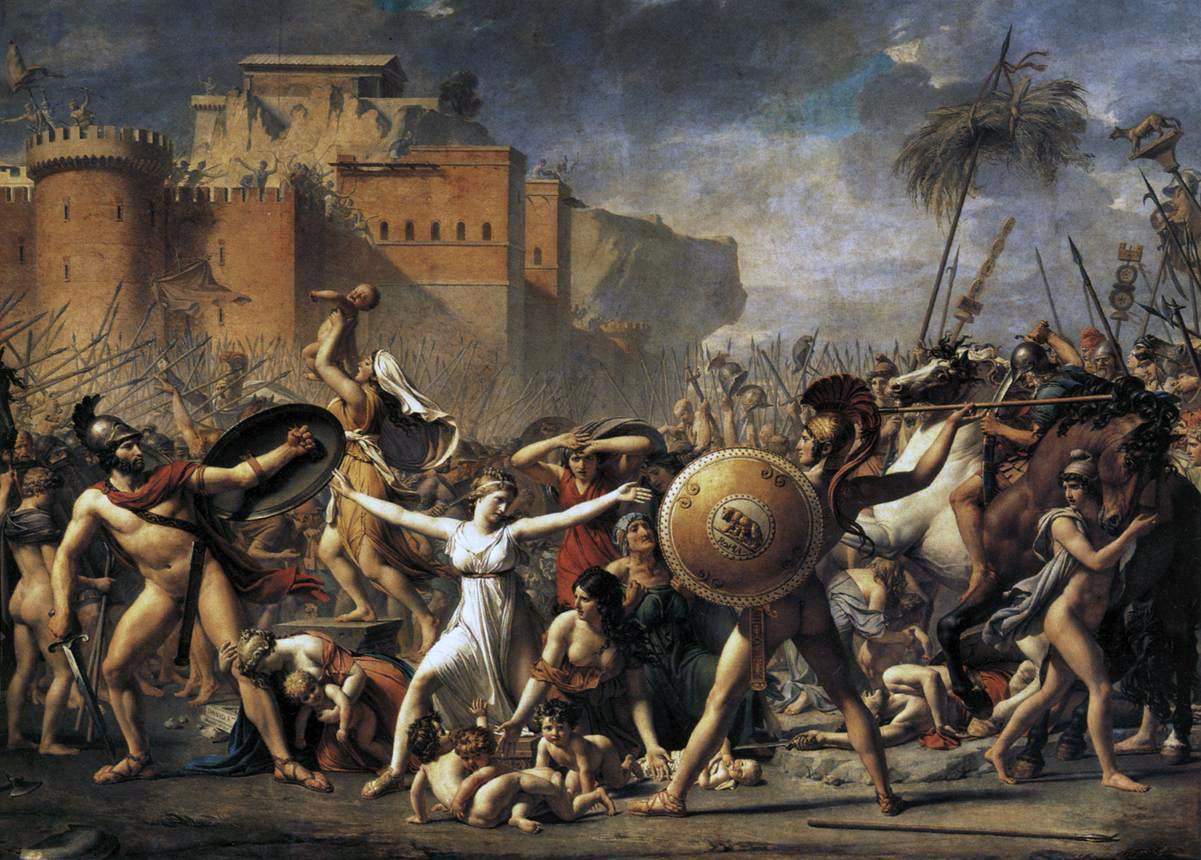
One of the reasons why the original Costume Parisien plates are so dull in comparison to the brighter revival ones is that the use of white linens and cottons was one of the ways women achieved this empowerment. White is a hard colour to maintain, even today, and white trains even more so, particularly in the days before proper sewerage and when the main mode of transport involved horses and unsealed roads. As a result, a woman's ability to remain in diaphanous white trains indicated a wealth that enabled her to be driven everywhere as opposed to walking through the dirty streets (owning and maintaining a carriage and stables), have her clothes washed properly (by servants), and having the wealth to be able to replace these white dresses with newer whiter dresses when desired. 


White empire-line gowns also replicated the clean sinuous lines of the classical statuary that had undergone a revival and represented the Roman Republic that was an inspiration for the new emerging France.


Monday, 30 June 2014

Response to a Lecture: Joan of Arc's choice of attire

A friend and I recently attended a free lecture at the Institute of Advance Studies on the reliability of the primary sources concerning the life and trials of Joan of Arc.

Joan of Arc is not someone I am usually interested in (she is the most thoroughly documented person in Medieval history and I prefer historical figures in the shadows or who have almost been forgotten completely) but the lecture was interesting. However being historians and already well aware of the reliability of source material, we came out of it more curious as to the reasons behind Joan's choice in favouring men's wear over women's, and why she did change back and forth between the two. The lecturer had made light reference to the impact of this on her trial and sentence but at the same time had implied that this was not an area he could answer, which was why he wasn't delving into it. Walking across campus afterwards, we, two young female historians, one interested in fashion history, the other in a woman's place in society, had difficulty understanding the difficulty the lecturer felt in justifying Joan's choice in attire. Even without assigning a saintly or Amazonian symbolism to her attire, historical knowledge and personal experience made it seem all too straight forward an answer.


A Timeline of Joan of Arc's attire:
1428
At Vaucoureurs when she stands before Robert de Baudricourt requesting an audience with the Dauphin  she is dressed as a woman in peasants dress referred to by Jean de Nouillempont  (aka Jean de Metz) as 'a red dress, poor and worn.'


Of her earlier campaigns she is later described as wearing 'relatively simple clothes... namely a long hood, a dark pleated tunic with belt and the hips and high leather leggings with pointed toes and attached spurs.'

Later she is accused of wearing sumptuous and magnificent clothes of precious cloth and gold cloth and also furs... She used all of the styles and clothes which the most dissolute men are accustomed to assume, having rejected all womanly modesty and being contrary, not only to womanly decency, but to that which is common to honourable men.*

March 15 1431
Having been arrested and held in an English military prison, guarded by men, Joan continued wearing her men's clothes. She is offered the chance to hear Mass if she will put away the men's clothes. In response she asks to have a long dress touching the ground, without a train, made for me and give it to me for going to Mass... [or then]... Give me a dress of the sort that a bourgeois girl would wear - a long skirt with something like a woman's hood - and I will take them to go to mass in.  This offer proffered no result.

Palm Sunday March 25 1431
Joan is asked if she would put on women's clothing so that she might hear Mass and receive the Eucharist at Easter. She replied that it was impossible for her, and pleased to hear the Mass whilst wearing male's attire as These clothes do not burden my soul, and to wear them is not against the Church. This request was refused.
Later that day she expressed her willingness to resume women's attire.

Thursday May 24 1431 
Joan signed an abjuration. She confesses that [she has] sinned grievously.... in wearing a dissolute habit, misshapen and dishonest, against the decency of nature, and hair cut round in the style of a man, against all honesty of the feminine sex. (I don't know whether Joan was aware she had signed this specific part, as she said she never understood that she had made and oath not to take back these men's clothes. It is possible this part of the abjuration was tacked on after she'd signed, something that sounds likely to have happened).
She is condemned to life imprisonment and led back to the English prison where she is outfitted in women's clothes.

Monday May 28 1431
Joan resumes wearing men's clothes and is accused of being a relapsed heretic.
When questioned why she has resumed women's clothes, Joan is recorded as responding that she had taken these clothes not long ago and had put off the women's clothes... that she likes these clothes better than women's clothes... I have done it of my own free will and because it was more fitting since I am with men. I began to wear it again because what was promised me has not been observed, to wit that I should to to Mass and receive the Body of Christ and be freed from these irons. Cauchon, her chief accuser and judge told her that when she had made her abjuration she had promised not to resume wearing men's clothing. Joan's response to this was I would rather die than remain in these irons, but if I am permitted to go to mass and be put in a decent prison with women to help me I will be good and do what the Church wishes. This was ignored by Cauchon.

Wednesday May 30 1431
Joan of Arc is burned alive.


In Joan of Arc's life, the wearing of male attire probably served a very specific purpose. She wore it because it was practical to the fulfilment of her mission and her role in the Military. One of the earliest mentions of Joan wearing male attire is upon her leaving Vaucoureurs. In one source she is described as wearing her uncle's clothes, in another those of her escort's servant.  Though she is not yet involved with the military, in both sources this is referenced within a few lines of a statement that a horse was procured for her for 16 francs. Regardless, of whom the clothes belonged to, two things are evident: the last minute procurement means that the choice of wearing men's clothing was not part of her existing peasant life or premeditated, and the men's clothing was a practical response to the fact that she would be riding to her next destination. The additional set of clothes she had, had been made for her by the people of Vaucouleurs who were now sympathetic to her cause.

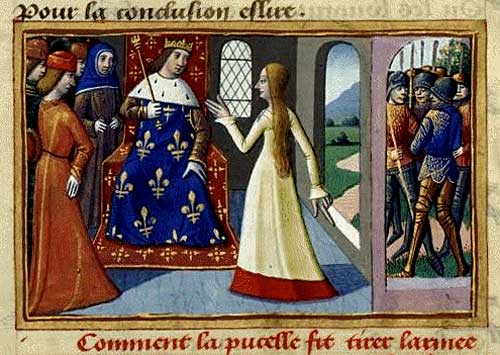
This is supposedly a tapestry of Charles VII meeting Joan of Arc, though it is a little difficult to tell which of the soldiers she is supposed to be. 

Dressing in male attire when on a battlefield or residing in an army camp is practical and understandable. For undertaking the pursuits of a soldier, long, cumbersome, skin tight dresses are not ideal, nor are long flowing locks. Instead, Joan wore men's clothes and had her hair cut in a 'generic masculine haircut'. Her clothes and masculine haircut make her one of the soldiers, an equal with the men she fought alongside and captained. Dressed as a man it would have been easier for her fellow soldiers to forget that she was a woman, that they were taking orders from a woman, a weaker vessel.

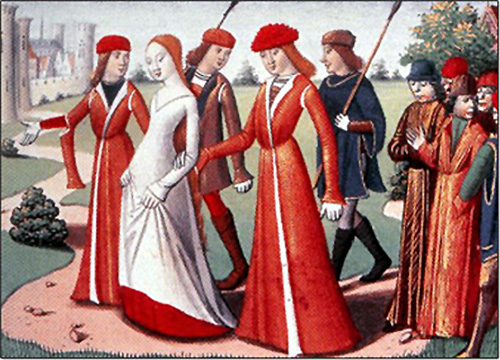
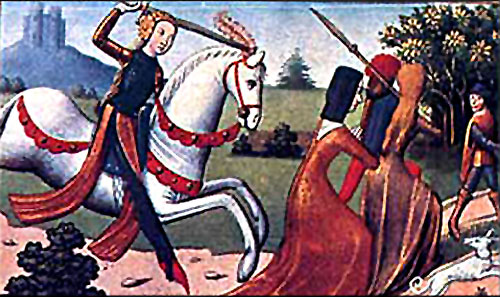
It also would have meant that though a woman, she was not associated with the women of the army camp, women who for the most part would have been whores and prostitutes. Looking at the depictions of Joan 60 years later in "Les Vigiles de Charles VII" by Martial d'Auverbne, her appearance in women's attire differs little from the depictions of the prostitutes in another of the miniature illustrations.

Joan of Arc being led to her execution from Les Vigiles de Charles VII by
Martial d'Auverbne written between 1477 and 1483
Joan of Arc chasing prostitutes from her army's camp from Les Vigiles de
Charles VII 
by Martial d'Auverbne written between 1477 and 1483
Throughout her mission, Joan appears to have been gifted masculine attire; in Vaucouleurs she was made and gifted 'mens suits, hose, and all that was necessary' while at Orleans 'she received from the magistrates a forest-green surcoat trimmed with marten... and a vermillion tunic trimmed with beaver. While the clothes from the people of Vaucouleurs would have been 'relatively simple clothes', those received in Orleans were fashionable garments similar to those she was noted as wearing later in her campaigns. Karen Sullivan in 'The Interrogations of Joan of Arc' says that this 'tendency to adorn herself in the manner of fops and in the manner of the most dissolute men suggests that she experienced her coiffeur, her wardrobe, and by extension, her body not only as a means to an end but as an end in themselves. Because the clerics perceived that Joan took pleasure in her masculine trappings, they concluded that she chose them out of the desire to experience such pleasure.' I wonder instead if this 'tendency to adorn herself in the manner of fops' was in fact due to her increasing fame and the clothes she was gifted as a result. Or simply the result of peer pressure and the desire to fit in with her fellow soldiers or fellow captains. Meanwhile, her 'desire to experience such pleasure' from her masculine trappings may instead have been due to the unusual beauty of the pieces, be they masculine or feminine, resulting from the fact that she would never have experienced such outfits in her previous life as a peasant girl. Secondly, she may have taken pleasure from them because being masculine clothes, they offered her a freedom and security women's clothes never could.


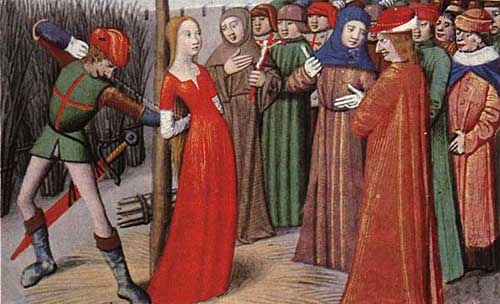
Joan of Arc's capture marks the beginning of a separate period of her life, where her choice in clothing came to play an important role in how she was viewed and what she was accused of. Upon capture she was treated like a prisoner of war and thrown into a military prison where she was guarded by men, as opposed to a prison for women  or where she could be guarded or protected by women. Whilst in prison, to the great consternation/delight of the accusers Joan retained her masculine garb. The question becomes, why? Was it simply that she was maintaining her military habits in a military setting, or was it that it gave her something female garb could not?

Given that Joan did not see her military position as a permanent one, despite the military profile of her imprisonment, but instead that when [she has]done that for which [she has] been sent on the part of God, [she] will take women's clothes, this decision is to continue wearing men's clothes is exceedingly practical. The impression is that Joan planned to resume her female life and as a result tried to ensure that when she was viewed by society as a woman she conformed to expectations and ideals. As a result, it was necessary that she retained the things most prized in young maidens: their virtues and more importantly, their virginity.

At the time of her trials she was 19 years old, an unmarried girl, but of marriageable age. As a result, she offers to resume her female clothes when she has [been]put in a decent prison with women to help me and chaperone her. In addition, when she is offered the chance to attend mass if she will wear women's clothes, she asks for a long dress touching the ground, and a dress of the sort that a bourgeois girl would wear - a long skirt. These requests are for something long and modest and as evident in this second request, for something appropriate to the station to which she hopes to return when her divine mission has been fulfilled. This stance is also supported by the terminology used to describe Joan of Arc throughout her life. The term pucelle (maid) is used as opposed to vierge (virgin) the latter of which would indicate a lifetime vocation of virginity; in the image to the right, Joan is labelled 'Pulzella'.


The date of interest is Thursday May 24 1431 when Joan signs the adjuration and supposedly voluntarily resumed women's clothing. Three days later, on Sunday May 28 her accusers/assessors learn that she has resumed wearing male's clothes. When questioned, Joan is recorded as declaring I did it on my own will. I took it again because it was more lawful and convenient than to have women's clothes because I am with men; I began to wear them again because what was promised me was not observed, to wit that I should go to mass and receive the body of Christ and be freed from these irons. ...I would rather die than stay in these irons: but if it is permitted for me to go to mass, and if I could have a woman to help me, I would be good and do what the church wishes.

from Les Vigiles de Charles VII by Martial d'Auverbne written between 1477 and 1483
When viewed alone, this doesn't make that much sense for Joan does not appear to be explaining why she has provided her accusers with the very proof they needed to prove her a lapsed heretic. What is interesting is what happened during those intermediary days. According to Jean Massieu, having resumed women's clothes on Thursday when she woke on the morning of Trinity Sunday she could not find her women's clothes because the English guards had stolen them and only given her men's clothes to dress herself in. Being a modest young woman, with a choice of men's clothes or nothing/her shift and being overseen by a group of male soldiers, it's perfectly understandable why she dressed herself in the men's clothes which [the soldiers] had thrown at her. 

Martin Ladvenu provides a slightly different version, one which ties in with what Joan herself said in response. On one of these intermediary nights, someone approached her secretly at night; I have heard from Joan's own mouth that an English lord entered her cell and tried to take her by force.  The questions asked of Joan after her resumption of wearing men's clothing were when and for what reason had she taken anew these men's clothes? Karen Sullivan's analysis is that Joan answered the first part of the question but would not answer the second. I believe that in fact Joan did answer the second part of the question: since [she is] with men. The men's clothes, including the leather leggings mentioned earlier, would not only have been less alluring to men contemplating rape but would also have provided more of a barrier to rape than had she been wearing a woman's gown (without underwear as we know it). 

Throughout the ages, women's clothes have been viewed as alluring, regardless of their length, tightness, shape... Almost because bodily features were hidden from view they became alluring and incredibly provocative. An example in point is the female ankle which was hidden beneath long skirts until the 1910s when suddenly its continued visibility caused it to lose its appeal. In an age where excepting the occasional female saint or characters from myths, women did not dress as men, Joan's choice of masculine attire (and masculine attitudes) would probably have played a huge part towards her being accepted by the army as a strategist and a captain, and more importantly as 'one of them'. Her return to women's clothing would have reminded everyone around her visually that despite her attitudes, her military successes, her intelligence and her divine callings, she was in fact one of the 'weaker vessels', a female.

    References: 
    *Primary source material is marked in italics throughout the post. However this has all been pulled from the secondary sources below and therefore I am unable to verify the translation or indicate which text it originates from. 
    Pernoud. Regine, Clin. Narue-Veronique, Joan of Arc: Her Story, 1999, Palgrave Macmillan
    Sullivan. Karen, The Interrogation of Joan of Arc, 1999, University of Minnesota
    Edmonds. Joan, The Mission of Joan of Arc, 2008, Temple Lodge Publishing


    Wednesday, 18 June 2014

    A Garden in Aestivation

    I haven't posted much on the garden of late, simply because with the summer heat most of the life went in to aestivation (hibernation due to excessive heat as opposed to excessive cold). Now that winter has definitely set in, I probably should look back on the past few months. 

    A spider constructing a cocoon or web from an old crunchy leaf under the eaves, away from the peril of hungry wattle birds. 


    With the red capped gum in full flower, the lorikeets were showing themselves to be true gluttons. Climbing onto the pillar to get a better angle I had a family of them shouting abuse as they deemed me to have crossed into their territory.


    After shouting a few choice phrases back, the braver ones decided the food was too good to give up and descended.


    The bees make the most of another flowering gum with branches too fragile to support the greedy lorikeets.

    Having coaxed it to flower for years, the golden shower put on a spectacular showing sending streams of sunshine down over the centre of the garden. 

    One afternoon, Mya was spotted trying to climb into one of the spindly Christmas-decoration grevillias. It wasn't a plant she usually devoted her attention to (being the local drink spot of her tormentors: the wattle birds) but on this occasion she seemed to be showing it unwarranted attention.

    That was until we wandered outside and saw this poor mouse clinging to the spindliest branches at the top of the shrub quacking with fear.

    (unaware that we'd rescued it, Mya spent the afternoon in the vicinity trying to renew her acquaintance with this new friend.)

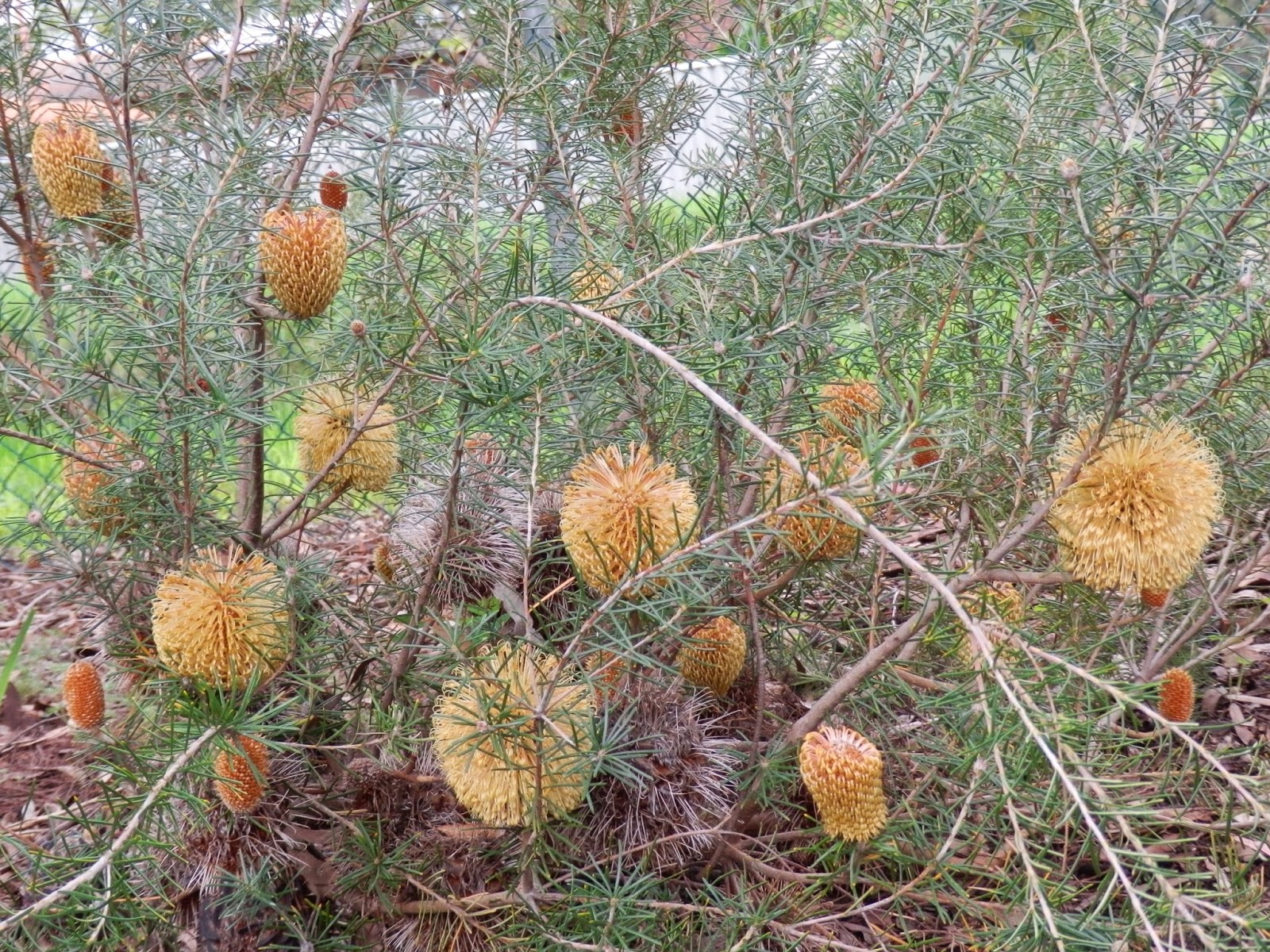
    Another of the ground covering banksias. A not-so-small shrub, this native remains inconspicuous until autumn when it sends out these vibrant candles, each one edged in brilliant red.

    Years ago, enduring the long drive from Esperance to Kalgoorlie to Perth, we stopped suddenly and unexpectedly. Mum had seen an unusual native that she wanted in her own garden. Having bought and killed (unintentionally) several, this one is thriving, if only to be used by the wattle birds to play peek-a-boo.


    Several years ago the red Pincushion Hakea decided to give up the ghost. It had been a beautiful tree, dotted with flowers of white pins sticking out of bright red cushions. It has been replaced with a pink version, dotted with similar flowers if not quite so striking.


    Slowly covering the garden, this native ground cover is a beauty to behold until such time as the weeds grow amongst it and make the process of weeding far more challenging.


    The scottish thistle dryandra.


    Autumn started with the appearance of the aptly named Autumn Crocus

    After the first rains:

    ... and the weeds who say 'wacko', and cover every other inch of the garden.


    With winter coming, a medley of bulbs were scattered throughout the garden. Already home to freesias and jonquils (erlicheer and paperwhites), and Ipheions, we added several others including these Sir Winston Churchill daffodils.


    Thursday, 12 June 2014

    More Mandarin-Limes (Rangpur Limes)

    Rangpur Limes seem to be one of those fruits that you don't really discover unless you know someone with a tree. In my case, that someone happens to be my grandfather, and as I couldn't bear to let the fruit go to waste, I have a sudden glut and a desire for more recipes. Because truthfully, a girl can never have enough amazing recipes.


    Finding recipes that cater specifically for Rangpur Limes was a little trickier than I'd anticipated. Normally I don't bother: a lime/lemon/orange recipe caters for all citrus fruits, but as I was making Jam I wanted something a little more specific, and then decided I wanted something that catered specifically for the deceptive colour/flavour combination of the fruit. I found the easiest way to find these less-usual recipes was by bouncing from one blog to another using the links sprinkled liberally within.

    What with me being a sweet tooth and appreciating the contents of the liquor cabinet, theses recipes sounded fun.


    Candied Rangpur Lime Rounds and Syrup
    courtesy of Martha Stewart

    I found this recipe while perusing my new favourite recipe database Yummly.com (unfortunately the US version is better than the UK one and there is no AU version).


    The syrup is that strange combination of sour, bitter and sweet and in a glass of soda water tastes like Tonic with a twist of lime and after-taste of the Rangpur lime. And truthfully, it probably contains about as much sugar as a bottle of tonic water does anyway.


    Rangpur Lime Syrup
    courtesy of WestoftheLoop

    Not realising I'd end up with a tasty syrup from the candied rounds (this syrup contained none of the juice and got all of its flavour from the skins of the limes), I decided to made another syrup, this one to drink with soda and gin and incorporate into margaritas and mojitos.


    1 cup sugar
    1 cup water
    1 cup Rangpur lime juice (about 8 large limes)*
    Zest from the juiced limes (oops forgot this one)

    Place the sugar and water in a small saucepan and heat, stirring to dissolve the sugar. (This is just a simple syrup). When the sugar is dissolved, remove the pan from the heat and allow the syrup to cool. Add the Rangpur lime juice and zest to the simple syrup and whisk together. Place syrup in a jar or bottle and refrigerate. Serve with sparkling water, sparkling wine or gin. Yum!
    *I stole the juice for this recipe from the jamming fruit as the jam seemed to have more than enough flavour to go around. 


    Rangpur Lime Gin
    courtesy of WhatJuliaAte

    I have yet to see it, but the internet tells me that Tanqueray makes a Rangpur Gin. As this doesn't seem to be available in local bottleshops, it's probably easier to make my own. Having discovered the amazing setting qualities of Rangpur Lime anything ( the fruit is packed full of pectin) I thought it might be wise to remove the pips, but having de-pipped so many for the jam and candied rounds, truthfully I couldn't be stuffed.  

    8 Rangpur Limes, quartered
    1 cup sugar
    1 bottle Gin

    Fill a seal-able jar with the limes and add the sugar. 
    Pour the gin over the top to cover the fruit (plus some)
    Store in a cool dark place and agitate the jar everyday for a month. I think I shall be storing it near my laptop to remind me to agitate it, and whet my appetite for when it is ready. 

    I'm curious to see which tastes better at the end of the month, the lime infused gin, or the gin soaked limes. 


    Rangpur Lime Jam
    ...because I had so many fruit I needed another batch. Besides, Granddad (owner of the tree) needs at least one jar and my first test batch didn't provide quite enough. 

    In addition to the basic Jam, I also decided to make a small batch of a sweeter Cinnamon Lime Jam and a smaller batch of Ginger Lime Jam. 


    Whole Rangpur Lime Cake

    There will be a few of these coming out of the kitchen in the next day or two. 
    Good thing I had a writing group to feed one to, and family for another. 


    A gift of Rangpur Limes
    My aunt (who made the marmalade that went so well with the pannacotta) who is this family's queen of preserves usually makes a batch or two of marmalade and so the remnants of the basket have departed in her direction. 


    Pity the tree is still not denuded. 


    Related Posts Plugin for WordPress, Blogger...