Thursday, 19 September 2013

Buzz Buzz Bumble Bee

There are many things I'd like to introduce to this small town for London, but perhaps the most whimsical are the bumble bees.


Here, bees are bees, streamlined, mean, unexciting gatherers who buzz around the gardens harvesting nectar and stinking poor unsuspecting people who get in their way.

They are delightful creatures, but after living in London, I find they cannot compare with the bees that drone around your typical English garden. 

European bees are like big balls of black and yellow velvet the size of a thimble hanging on gossamer wings. When the garden is ablaze with colour, they gorge themselves on the pollen to the extent that they become too heavy for their own wings. As you sit watching, they waver across the garden with the appearance of heady drunkenness. 


They were such a delightful sight though one that is impossible to photograph as their movements were so erratic and unsteady they are difficult to focus on. Only when they flew indoors and landed in my lamp shade were they able to be photographed...

...or when they'd lost themselves in the luxury of a virginal flower.


Sunday, 15 September 2013

Night Lights

London has never had a reputation of being a romantic city; it's too business orientated, too fast paced; too much of the history and culture of the city is lost in amongst the shiny new skyscrapers of the City. 

What's needed is a different perspective, a view that makes you forget the hustle and bustle of Oxford St, the bright lights of the West End after dark, the never ending list of free museums you simply have to visit over the duration of your short stay. 

To get that different view point I've taken to putting this trip on the must do list of family and friends who find themselves in this fine city with a free evening on their hands. 

Starting in Greewich is probably easier; a day at the Cutty Sark, National Maritime Museum, Queen's House, Greenwich Observatory, the Greenwich markets, feeding squirrels in the park... take your pick. 

After darkness has descended, (sometime in the early afternoon if you;re visiting in the middle of winter) walk down towards the Thames with the plan of catching the Thames Clipper back into the city in time to catch a show of grab a bite to eat. 

However before you do, turn back and look back towards the observatory, streaking though the London sky towards Canary Wharf is the green laser that marks the meridian line. By day its a line in the cobbled pavements, by night this brilliant slash of colour across the black and cloudy sky. 


Catching the Thames Clipper into town you pass under and by some of London's famed monuments but from the vantage point of a more striking angle and illuminated to stand proud and tall from amongst the skyscrapers that dominate the skyline. 
While it is an angle that has been familiar to Londoners and tourists alike for centuries, it is only in the last century that we have had the benefit of gazing upon these magnificent edifices, some only constructed in the 20th century at a time when London was the very epicentre of a global empire and at the height of its power. And it is more recent than that again that we have begun illuminating them at night to the joy f camera wielding tourists like myself. 


One of the newest monuments of the skyline is the Shard. A shining colossus of steel and glass projecting upwards above and beyond the range of much of London's infrastructure, When I arrived it was little more than a hole in the ground, and I hoped that when I left more than two years later it would be complete. Alas, this is nearing completion but still incomplete enough from foxes to clamour inside and check it out for themselves. 

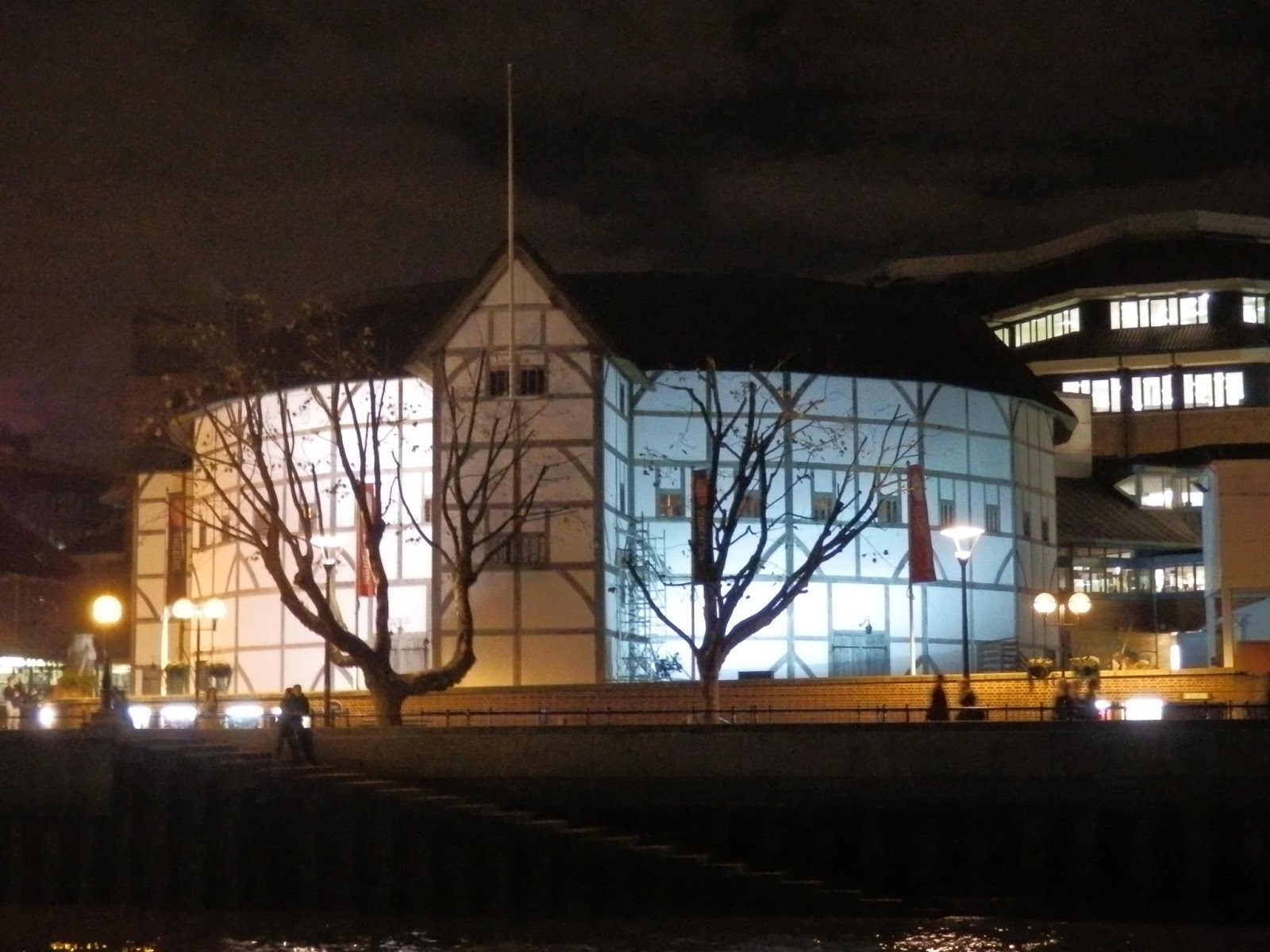
Shakespeare's Globe Theatre

The Oxo Tower (looking more like an incomplete game of naughts and crosses)

St Paul's white dome glistening above the boats that line the embankment between Charing Cross and Temple. 

 Circling under Charing Cross Bridge you pass the London Eye, Big Ben and the Houses of Parliament before coming to a stop within walking distance of Trafalgar Square and the entrance to the West End. 


Sunday, 8 September 2013

Winter Wonderment

Winter feels prolonged this year; it's September and still the gales are blowing and the dams are slowly filling. Stepping outside you feel inclined to pack a wind jacket and umbrella in spite of the deceptively blue sky.

Though spring is slowly creeping into the garden, it is still winter enough to warrant another post.


The Physalis is fruiting though it is the insects that have made for such a stunning display of the seedpod. I keep meaning to dry them for the remainder of the year, but they never make it far beyond the bush.


Between branches silken strands catch at the glow of the dying sun, illuminating the prey within. It is the only time such a net does not disappear against the busy background as it stretches out across a path, or between the frames of a doorway.


This pink boronia is quietly celebrated having survived this long. It has been left alone, forgotten about, in the hopes that unlike its predecessors it would not provoke and die an unexpected death. Lord knows what the grevillia below is thinking, though it too appears to like the idea of being likened to a Christmas decoration. 


One of my favourite parts of winter is the swathes of wattle that fill bush land and pepper the sides of the freeway. Growing up we had a tree that you could stand under, and tilting your head back, submerse your face in the subtle sweetness of the flowers. Today, this tree is long gone, replaced instead by others, this sandpaper wattle among them (with the flowers as downy as ever, it is the texture of the leaves that gives it its name).


And yet there are still reminders of Spring's approach; in the park a lone pink and gray galah keeps watch from the branch outside his nest, cocking his head at every noise and passer by. It remains to be seen whether spring will be so fortunate and bring with it the plaintive cries of baby birds. 


Saturday, 7 September 2013

When Lime is the key (Key Lime Pie)

I know I'm stuck on a bit of a theme at the moment, but one should be promoting the food that in season. So, what do you make when you want something different, but still have too many limes that need using?

Key Lime Pie.

Usually, I try not to use sweetened condensed millk. It has a reputation of being that little bit too sickly sweet.
My sister on the other hand always used it - or so i'm led to beleive, resulting in the presence of one lonely tin sitting in the back of the pantry.

Unlike most of my cooking, this particular creation actually came with a cause: dinner at my cousins'. Given that she cannot eat raw eggs at the moment, a scrounge around the internet resulted in a selection of recipes to chose from. The draw card of this ones was limited cream and a prolonged cooking time, to ensure the 4 eggs had no chance of being anything but cooked through.

Like most cheesecakes (this is really just a cheese-less cheesecake) the base comprises of pulverised biscuits glued together with butter. Rather unintentionally, for this particular pie I ended with an anzac-style crust having used honey(double it) instead of sugar and coconut instead of the almond meal of the recipe.
Perhaps it just made it all the more exciting.

The filling itself is not the healthiest of combinations, but then who am I kidding, my desserts never intend to be healthy. It's very basic, and very easy to whip together, but has a good kick of flavour whilst retaining the creaminess you'd expect of a cheesecake. In fact, that it uses a whole four limes as opposed to the one used in the lemon cake has made it my new favourite lime dessert.

*Photo updated based upon comment below. 


What I do recommend is serving it with cream though; otherwise you might find it just that little bit too limey.
And for the recipe... www.taste.com.au/


Tuesday, 27 August 2013

The bells of St Clements (Lemon Cake)

There is a lemon cake thats rather divine. It's made from one whole lemon pulverised in the food processor, and provided you remember to include all of the recommended sugar, makes for a very nice cake. Provided you remember the sugar.

Growing up my mother would always adapt recipes as she baked. Usually this entailed halving the sugar. With the Lemon Meringue Pie this entailed cutting down the sugar to one third in addition to increasing the amount of lemon juice. With cakes, muffins, brownies... the sugar was always reduced, and it rarely had much of an impact.

Its the way I've been brought up. Usually when I'm baking I try to resist that, following the recipe to a tee, only altering the other ingredients included around it. Except when it comes to cakes. For some reason, it feels illogical that the standard cake recipe contains an entire cup of sugar. Surely it's not all necessary.

Turn out, in the whole lemon cake it really is.
Being healthy - as much as one can when planning to eat cake, I cut down on the amount of sugar. It took a very sweet friend to pull a funny face (when she thought I wasn't looking) for that decision to be reversed ever after.

So, here's the proper recipe:
For the cake:
1 whole orange or Lemon, well washed
1 cup sugar
3 large eggs
12 Tablespoons unsalted butter, melted (180g because no one measures that much butter in tbsps)
1 1/2 cups all-purpose flour
2 1/4 teaspoons baking powder (if you don't have plain flour and baking powder just use self raising flour instead and omit the baking powder quantity: It works just as well)
3/4 teaspoon kosher salt
1 Tablespoon poppy seeds (optional)

for the glaze:
juice of one lime/lemon
2+ tbsp of sugar.

Position a rack in the centre of your oven. Preheat the oven to 180 degrees Celsius.
Use a pretty shaped silicone mould or grease an ordinary cake mould.

·         Using a sharp knife, remove the little green stem from the orange skin. Cut the orange into 8 pieces.
·         In the bowl of a food processor fitted with the metal blade, pulse the orange pieces (skin and all!) and 1/2 cup of the sugar until puréed, scraping down the sides of the bowl as needed, so that no large orange skin pieces remain.
·         In a large mixing bowl, whisk together the eggs and the remaining 1/2 cup sugar until smooth.
·         Stir in the orange pulp. whisk in the melted butter to combine.
·         In a separate bowl, whisk together the flour, baking powder, salt, and poppy seeds to combine.
·         Sprinkle over the orange mixture and, using a rubber spatula, gently fold until just combined.
·         Pour the batter into the prepared loaf pan.
·         Bake for 50 to 60 minutes, rotating the pan halfway through baking.
·         The cake is done when a wooden skewer inserted into the centre comes out clean. 
·         Immediately it is out of the oven drizzle the hot lemon syrup all over the cake. 
·         When the cake has cooled unmould.  
·         To make the lemon syrup boil together the lemon juice and sugar until the sugar has dissolved. (this is easily done in the microwave). 

Try not to eat too much of it.

Saturday, 24 August 2013

A Review: Noel Coward's Easy Virtue.


Living in London, there was one type of show I was dis-inclined to see; those that were based upon movies.
It's not that I felt the story-lines and characterisations were inferior to those of books and scripts, just that I didn't understand the point of transposing a visual piece from the screen onto the stage. The joy of the theatre  is centred around interpretation of a different medium, the visualisation of a written work.

This weekend, some friends and I headed out to see a performance of Noel Coward's play Easy Virtue. The play itself is delightful; it doesn't attempt to say much, instead preferring to be an unflattering mirror held up to the English society of the time. It steers clear of discussions of race or colour, or nationality identifying none but the narrow-minded English family into which Larita has married and their slightly more broad-minded circle of friends and desired relations.

Noel Coward is renown for his wit, the speed of his dialogue and the double entendres liberally scattered throughout. Each of these essential elements were missed entirely by the actors and the director. Instead the actors performed as though reading the play for the first time, or at most attempting to replicate the movie made just a few years prior.  Admittedly, alternative interpretations of a source are to be encouraged, but when you are just rehashing a pre-existing (and not very good at that) interpretation it no longer becomes note worthy or interesting. Instead it just makes the director and actors appear to be inept at their craft. In this performance, Mrs Whitaker was an attempt to play Kristen Scott Thomas playing Mrs Whitaker and  Larita was much the same, replicating the styling, colouring and accent of Jessica Biel. Nowhere in the script is it indicated that Larita is blonde, American, or has a penchants for silk pyjama suits. What the script indicates is a dark haired, catholic, older woman who frequents Cannes and has lived in New York in her adulthood. These, and the sexual innuendos mentioned throughout, instead point towards a French woman of sufficient experience and means who was perhaps perfectly at home in the up and coming Art Deco movement in Paris as she was mingling with people of money and class on the French Riviera.

In addition, Easy Virtue is supposed to establish the extreme dichotomy between Larita and the family into which she has married. She is the black sheep. She is the one who is supposed to stand out like a sore thumb. Instead the set and backing artists provided the appearance of a cabaret show where Larita, sashaying around in her red silk pyjama suit is perfectly at home and comfortable, and the Whitaker family are the ones displaced.

The actors are supposed to be able to master the art of performing in different accents. Unfortunately in this instance, the ensuing reaction to almost all of the accents was clearly not one of appreciation. Even those who have not been anywhere near England, the BBC or such fashionable shows as Downton Abbey would have failed to place these accents anywhere on the British Isles. Only one character, a minor one with little more than about three lines had any success, producing at least a very stereotypical lower-class country accent.

It was an interesting performance to see, but it was almost more worthwhile reading the script and imagining the staging for myself.

Monday, 19 August 2013

A garden like no other (Monet's Giverny).

One of the hardest things about going overseas and visiting world renown gardens is that most of the time they still don't compare. I am extremely blessed with what I have situated just outside my door, but on the odd occasion I stumble upon a garden that really is worth writing home about. The most recent occurrence of this was when I was in France with family.

It was the beginning of spring: winter's weather with the colours of spring.


In the Jardin des Tuileries this was relieved by the cherry blossoms (or similar) that dotted the paths.


 In Jardin du Luxembourg the colours amplified again with beds of tulips defining the paths along which we were allowed to walk.


But this was nothing compared with Giverny.

Giverny is a small town outside of Paris, but referes more specifically to the garden of Claude Monet. It is the subject of countless of his paintings, including the water lily series (pl).  the inspiration behind his famous water lily paintings, the green bridge crossing the personal lake, painted in all seasons.

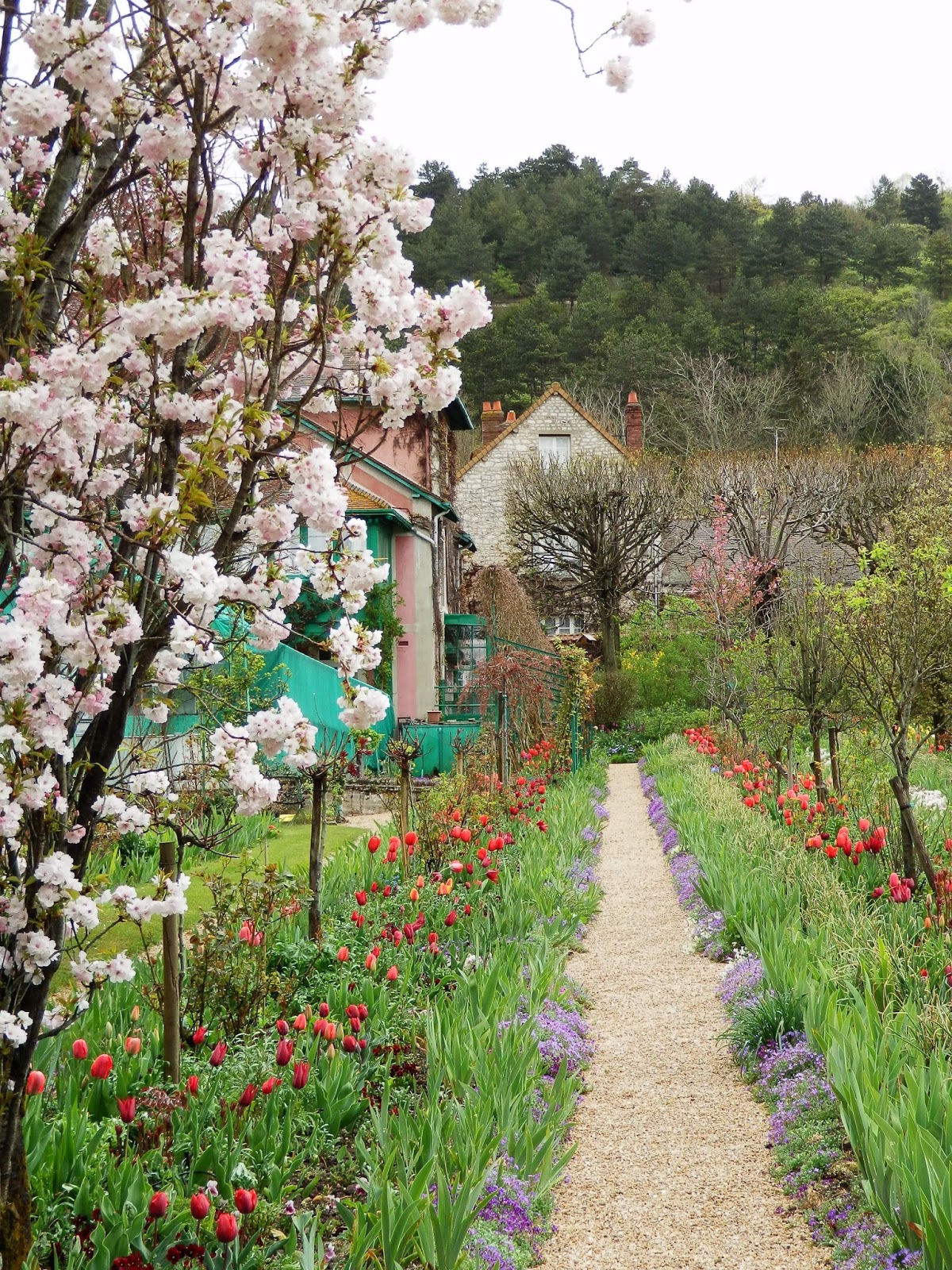
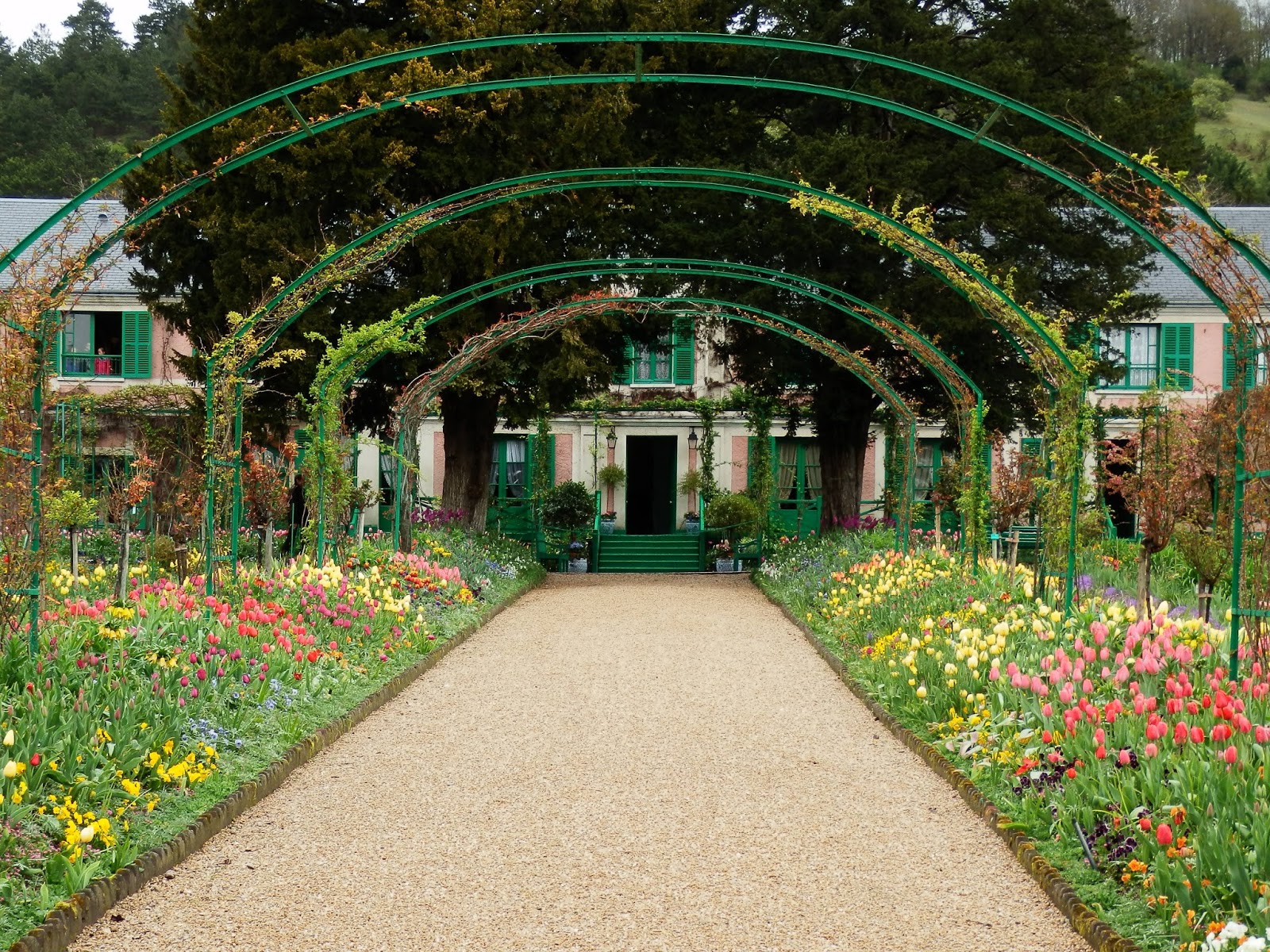
Giverny has been planted to ensure that no matter what the season, the time of year, the weather, it is always alive with flowers. Had we gone latter in the year this would have meant tentacles of nasturtiums weaving their way across the paths, a sight that is as familiar to me as a eucalyptus must be to a koala; in our own garden, nasturtiums are viewed as little more that pretty weeds that get ripped out as often as they get left alone. In the iciness of France in April this meant beds of tulips, daffodils and hyacinths while in the trees above the pink apple blossoms were slowly unfurling their petals, clinging to the remnants of the recent rains.


I don't think Monet expected to see hoards of small children scampering across his bridge shepherded by teachers and parents each one petrified lest one should happen to 'accidentally' fall in.


I suppose if you cannot afford a house of glass, or it's just not a practical suggestion, the next best thing is to paint your house to reflect back the colours of the garden around.


A sunset tulip, providing the warmth of colours missing in the sun.


 I have no idea what this is, though I know I've been told at least twice already. I just can't think of it as anything other than a very catholic bleeding heart bush.


Thank you Monet.


Related Posts Plugin for WordPress, Blogger...