Monday, 22 April 2013

Irresistible chocolate biscuits

I'll admit, once I find a recipe I like I hold onto it, to the detriment of trying new ones.
I'm a bit of a perfectionist so it can't be any old recipe, which is why I'm still searching for the perfect chocolate cake recipe.
When it comes to chocolate biscuits though, this recipe takes the cake.

It's decidedly versatile and the biscuits are demanded by family and friends alike.
In fact, I left a jar of them at the last place I house-sat and am being invited back, possibly in the simple hopes that I'll refill the cookie jar. On other occasions, friends across the waters have seemed incredibly disappointed that I have arrived to visit them without a filled jar firmly wedged into my suitcase.
Strangely, offering up the recipe doesn't seem to provoke the same response.

As always, the exception to this is CM who has taken up the recipe and made it her own adding glace cherries, nuts or whole fantales to the batter for an entirely different experience in decadence.
I'm a little less adventurous, preferring to tweak the amount of chocolate to levels some would consider obsessive, or  play with the cocoa depending on the colour I desire.

Take 75g caster sugar (the original recipe calls for golden castor sugar, but I'm just lazy and refuse to spend that sort of money when white caster sugar more than suffices.), 75g soft brown sugar  and whisk with 75g softened butter until pale and creamy and fluffy.
Add 1 egg and 1 teaspoon of vanilla essence ( I often forget this or double/triple the quantity depending upon my mood).
Whisk again until it's uniform in texture, light and fluffy and almost stiffening slightly.
Sift (I often can't be bothered) in 1 pinch of salt (again, often forgotten), 150g (1 1/4 Cups) of self raising flour and 25g (1/4 cup) cocoa powder. (Now, I tweak here. provided the total weight of dry goods is 175g, it really doesn't matter if this amount contains 50g cocoa powder to 125g flour, or no cocoa powder whatsoever. However I do recommend getting the lumps out of the cocoa powder.)
Now is also a good time to dump in the chocolate chips (or finely chopped block of chocolate if you refuse to pay choc chip prices). The recipe calls for 100g. 200g is probably a more accurate measure if you want to replicate what I make. Think of it as the batter being there to hold the chocolate chips together, so test this to the limit by throwing in the kitchen sink.
Form into balls and press onto a tray. Teaspoon size is good as it gives you lots of biscuits. Soup spoons are even better if you have no intention of sharing.
Bake at 180C for 10-15 minutes depending on crunch vs chew preference.

Convince house-mates you haven't been baking and enjoy a relaxing cuppa.


Sunday, 21 April 2013

That House

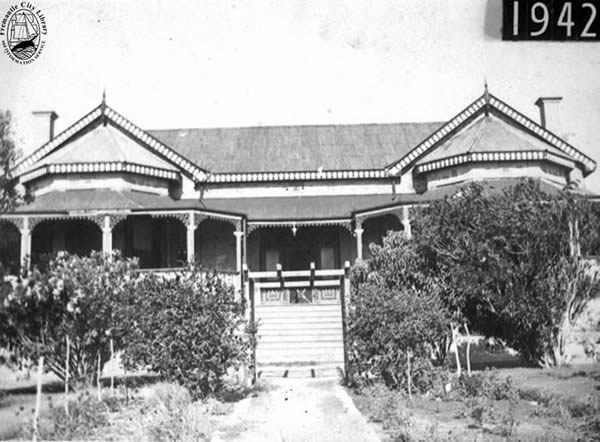
In Fremantle exists this house, an old Federation house with a history of prominence, life, dereliction and disaster, and every time I pass it I feel the need to pause and just stare at the facade that sits back from the street surveying the world as it passes by.

It is just an old house, significantly larger, more stately than the typical Federation house that dots the Fremantle hills. Large shady verandahs in perfect symmetry frame the front steps leading up in through the front door and down towards the coast and the sun setting over the sea below. It is just another old house, yet when I pass it, I feel drawn to stop by something more than its dilapidated stateliness. The paint in flaking, the colours fading but even before its newly manicured lawns were created it had a peace and serenity about it.


It is like a Greek grandmother who secure in her old age, her position in her community, what she has achieved and seen of life, sits out the front of her house and watches the world pass, watches the younger generations worry about settling down, supporting their lifestyles, finding their place in the world.

The history of the place is in keeping with the area, unseen, unexpected until one start listening to the stories of one's elders and digging through the archives. It was the home of Elias Solomon, Mayor, Member and business man for Fremantle before becoming Nurse Sheedy's Maternity hospital in the 1920s. The next I know of it, it was the setting of a murder by an escaped prisoner in the late 1970s/early '80s, but digitalised newspapers are unable to verify this.


For me it is a house that inspires. Inspires dreams of what I want to own, what I want to discover, uncover about the past, what I want to create and fictionalise even if it never lives up to the incredulity of reality.

Wednesday, 17 April 2013

Wedding Bliss

I've never been a fan of weddings.
Is that bad of me?
I just don't get excited as others do.
Yes, they are beautiful occasions filled with love and happiness and joy, and they are a time for family and friends to come together and share in these emotions that are radiating out of your lives.
But I've just never been an avid fan.

I suppose the prime reason is that for me, weddings are superfluous. An expensive surplus I might add. The use of hard earned funds that would be better spent on a mortgage or holiday.
My parents aren't married.
Never have been - to each other. Have never needed to be. So yes, I am a bastard. But it's never been an issue. I have never had to deal with negativity as a result. When people find out they're surprised more than anything, but by then they know me for me, not me for my parents marriage license. Perhaps there are a few stories floating around, of the struggles my mother underwent to stop my school referring to her as Mrs.  But nothing more than that.

I suppose it hasn't helped that the 'happily ever after' of Disney's princesses never reared its ugly head in my childhood. Marriage was taught through real people. Family members who decided not to marry. Family members who married and then divorced. Family members who married and perhaps should have divorced had religion or financial circumstances allowed. Family members who married and then ignored the conventions of marriage altogether. Family members who weathered the storm and came out stronger.
It was never viewed through rose-tinted glasses.
Never treated as a life ambition. Education and Self Identity held that position.

However I understand that most people are not like me.
I do.
Most people like a wedding. Most people like to witness the beginning of a marriage, of a new start to a new life together. But unless its the wedding of acquaintances rather than family and friends, its a (quasi)religious ceremony followed by the same conversations by the same people at greater expense.
And as the evening unfolds, stories emerge of the torment of arranging the venue, annoyance of chasing up rsvps, expense of getting the dress fitted, anguish of choosing the photographer, disgust at the selfishness of a bridesmaid, time involved in making the place settings, time involved in writing the invites, time involved in addressing the bonbonerie, time involved in making the table decorations, time involved in setting up and cleaning up the reception hall...
So, by all means, get married, it is after all your decision, not mine.
Just give me something to do so that I may ease your burden as opposed to adding to it.

Saturday, 13 April 2013

Mastering Macarons: Wedding Edition

My neighbour got married.
This weekend.

And his angel of a sister has put aside her studies to construct the wedding cake, a tower of multi-coloured, multi-flavoured macarons capable of feeding 200 guests. It is a truly selfless act to which I have been witness and willing collaborator as these macarons have been tweaked and twisted while A is driven to the brink of frustration in a bid to ensure they are the very epitome of perfection. Each filling was perfection in taste, some  'requiring' more than the smallest of tests before the piping began, the cooks making the most of the delicious fillings before they would have to be shared with the stampede of wedding guests they guaranteed.

By the time I came on board close to 1000 shells sat carefully stacked in boxes in the freezer awaiting the preparation of fillings before the frustrating construction of each individual macaron. As a rainbow of colours spilled onto the kitchen counters A and I set to work solidifying each filling before pairing, filling and twisting the macarons together before they could be returned to the freezer for their journey down south.

The colours themselves were divine, but when combined with the array of fillings...
Red the colour of thick matt lipstick, softened by a butter cream flavoured with rose.
Oranges ranging from the soft warm tones of dawn to the vibrancy of a perfectly ripe orange. These were filled with a seriously delectable salted caramel that deemed itself too delicious to stay sandwiched between bright orange shells.
Yellow of lemons twisted together with a glob of delectable passionfruit curd.
Green contrasting between a brilliant chartreuse and a rich dark shade usually associated with moist wooded forests. These were filled with a rustic pistachio ganache.
The Blue of a blue hawaiian cocktail complete with a toasted coconut Malibu ganache and
a dusty Purple, a suitable accompaniment for the lavender butter cream within.


After the dramas of semi-solid filling, fillings dripping as they sat waiting for their moment in the light, fillings running out the door... we got it. It worked. Each one looked spectacular, the colours aligning with the bridal party. Each one sat perfectly still, waiting to be devoured. And each one tasted divine.


So to my darling friends, and family. While it looked spectacular and tasted even better, think long and hard before you dare ask.

I refuse to devote that much effort and that much pain without some serious bribery.

Sunday, 17 March 2013

The language of love in 'Unveiled: 200 years of Wedding Glamour'.

In this day and age, there are several elements that conjure up the image of a wedding; the big white dress, the white veil though there is debate as to whether it is worn covering the face, and the tradition of something old, something new... however while we view these as age-old traditions, they are each one younger than the time span of the Western Australian Museum's wedding dress exhibition Unveiled: 200 years of Wedding Glamour from the Victoria and Albert Museum in London. Instead, the traditions relating to bridal wear have evolved over the last 200 years like the very fashions used to illustrate them.

Queen Victoria of England is often attributed with popularising the wearing of white by the bride at weddings. However although she increased its popularity, white was already a popular choice with brides dating back to around the turn of the 19th century. The earliest fashion plate depicting a white wedding dress dates is French and dates to 1813 while an English one is known to exist for 1816. In this the bride is dressed in a white gown, complete with the lace veil thrown back of her face and cascading down her back. The reason the bride is depicted in white is because for those who could afford it, white was worn to indicate the wealth associated with the marriage. For Royalty and the Aristocracy, gold or silver threaded cloth was used. For those who couldn't afford that, the next level down was white cloth, for its use indicated a marriage with the wealth to afford servants to launder your clothes for you. It must be remembered, this was a time when bridal gowns were not worn once as they are today, but became the bride's Sunday best or an evening dress for the first few years of her marriage and therefore needed to be laundered frequently.

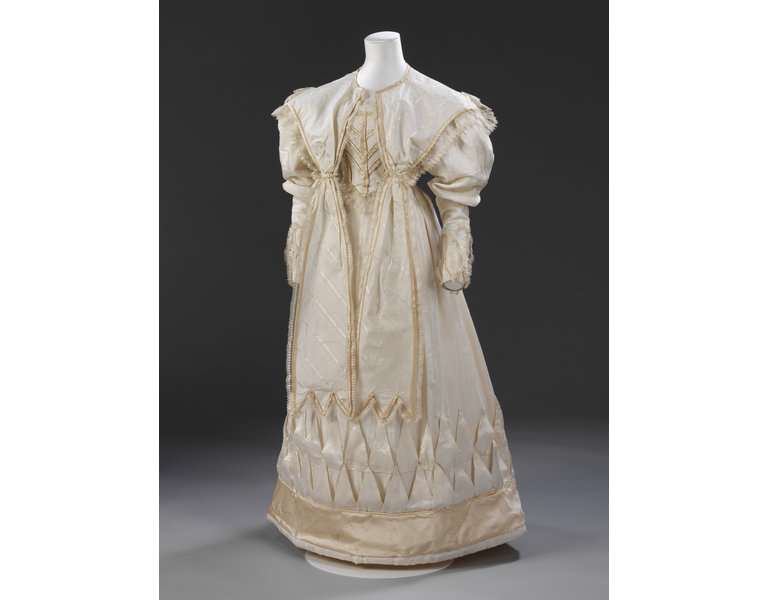
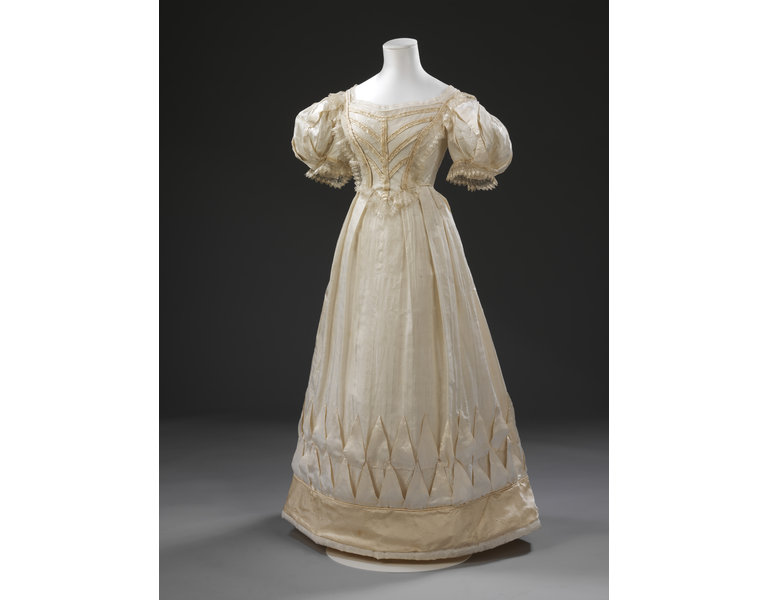
In Unveiled this lifespan of the wedding dress is visible in several of the gowns through their versatility. One of the earliest gowns in the exhibition, dated to 1828, were designed to be worn with a high neckline and long sleeves for the wedding service (possibly in keeping with the requirements of church) but possessed a removable pelisse that allowed for a lower décolletage and sleeves that could be removed, revealing short puffed sleeves encased within.


In later gowns dating to the mid 19th century the gowns often came with an additional bodice to provide the low scooped neckline and short sleeves required in evening wear.


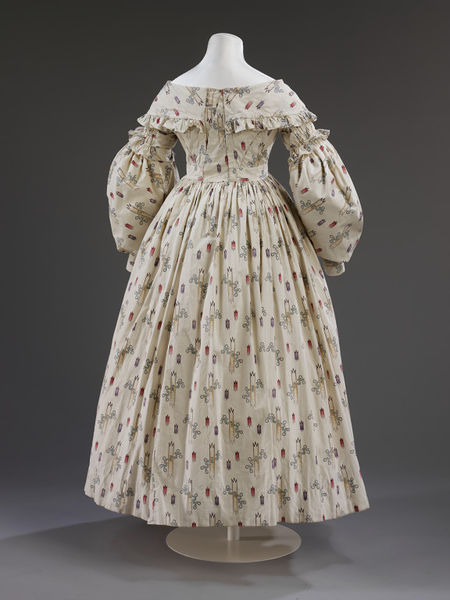
Those who couldn't afford white were likely to have a new dress made (or make it themselves), but in a fabric that was more practical for the social status of the bride and the dress's future use. It is for this reason that the Western Australian Museum has a brown satin wedding dress and the exhibition contains the cotton dress of a farmer's wife.
This later gown is a rarity in the Victoria and Albert collection because it belongs to a working class woman and has survived, as opposed to being worn until the fabric gave out. For Sarah Maria Wright a white dress in the latest fashions was impractical so what she did was construct a dress in a style that was more than a couple of years old but one more befitting her rural setting, and in a fabric that was not only appropriate for a farmer's wife but would have been easier to maintain. To keep it modern, Sarah chose a fashionable up-to-date fabric with a print that has been dated to c1840, within a year of her wedding. This dress also confirms that the gown was worn again after the wedding for down the back of the bodice there is an approximately 12cm wide insertion, possibly to allow the gown to be worn during the first few months of pregnancy. 

In 1840 Queen Victoria married Prince Albert in a profusion of lace, white, orange blossoms and myrtle, establishing a fashion that is still being propagated to this day. The lace that decorated her skirts and was worn as a veil was Honiton lace, an exquisite local lace that supported and stimulated the British cottage industry.

It was in the Victorian era that the symbolism of the white wedding dress changed to acquire the current meaning of purity and virginity. It is worth wondering if this was a result of the changing emphases of Victorian morals. Did the increased emphasis on monogamy, childhood and the immediate family result in brides wearing white to 'prove' their purity and virginity thereby guaranteeing the paternity of her children and her suitability as their role model through the innocence of their childhood?

In a similar way, did the increased popularity in the 1920s of wearing the veil to cover the brides' face as she walked down the aisle stem from the looser morals of the age and a desire to illustrate a personal modesty and purity in spite of the world around? Though we now consider veils to be a standard piece of bridal wear, this is a very recent tradition. In the early 19th century, veils would be worn as a fashion accessory by the bride, the bridesmaids and even some of the wedding guests. It was only later that they became wedding accessories, wore as an alternative to the bonnet as the obligatory head covering to a church wedding.

Similar to the early use of white, Orange Blossoms were another indication of the wealth associated with the marriage. Orange Blossom is the flower of the Orange, a plant that prefers the warmer climate of Valencia, Spain to that of England. For this reason, real orange blossoms had to be imported or cultivated at great cost in glasshouses. However, because Queen Victoria had made them fashionable, brides took to carrying and wearing wreaths of artificial orange blossoms perfumed for greater realism. These were fashioned from cotton, feathers or wax, though under the heat of candles, the later had a tendency to melt...

During the Victorian era, orange blossoms also gained symbolism through the ascendency of a Language of Flowers. In what became the height of fashion and was even incorporated into Queen Victoria's everyday conversation, each flower was attributed a meaning, and the flowers worn on the wedding day were used to express the emotions of the bridal couple and the hopes and expectations of the year ahead. For example, the pea pods on a veil dating to circa 1850 are symbolic of fruitfulness and happiness. The orange blossom many brides continued to wear was symbolic of purity, chastity and loveliness (your purity equals your loveliness), while the myrtle also popularised by Queen Victoria symbolised love when apart and fertility. This reference to fertility possibly derived from the plant's association with the Roman goddesses Venus and Ceres, but also stemmed from the ease with which myrtle sprigs took root. In fact the sprig Queen Victoria carried at her wedding was planted and has provided the myrtle sprigs carried by subsequent royal brides including Catherine Middleton at her wedding to Prince William of Wales.


Catherine Middleton utilised this Language of Flowers at her 2011 wedding, with her bouquet comprising of Ivy; symbolic of Fidelity and Friendship, Myrtle; symbolic of Love when apart, Hyacinth; Constancy and Unobtrusive loveliness, Lily of the Valley; Reciprocation of happiness and Sweet William; symbolic of Gallantry.  
This language of flowers was not only utilised by the brides, but also by the grooms in their outfits. We often assume that in the Victorian era the groom just wore his ordinary clothes. This is known to be an inaccurate assumption, not only due to the existence of advertisements for wedding shirts and waistcoats but also through the history of some of the articles within the collection. One particular waistcoat contains a handwritten label attesting to its wear by a bridegroom. Another indication of the providence of some articles as wedding wear is through the presence of the language of flowers in the fabric or embroidery of the article. On one of the waistcoats, lily of the valley and forget me-nots have been hand stitched around the front edge, the former symbolic of reciprocation of happiness and the later true love or forget-me-not. A third example of the use of the language of flowers is in the white lilac decoration on a bonnet. This was symbolic of youth and may have indicated that the bride was marrying her first love or childhood sweetheart, or have just been rather young at her wedding. By the end of the 19th century, much of this symbolism had faded, or disappeared completely. Even among the more natural Aesthetic ideals the depiction of flowers had become purely ornamental. Orange Blossoms were still present at weddings, in a stylised fashion, but it is more likely that this was because they had become a part of the wedding tradition as opposed to due to their symbolic meaning. Other elements came to the forefront, emphasising instead the brides' personality and own interests, but the language of flowers did not die out entirely. Even today, it still plays a small role in some fashion labels and is remembered (or at least accessible) enough to provided additional meaning and symbolism to the royal wedding of the Duke and Duchess of Cambridge. 

Friday, 15 March 2013

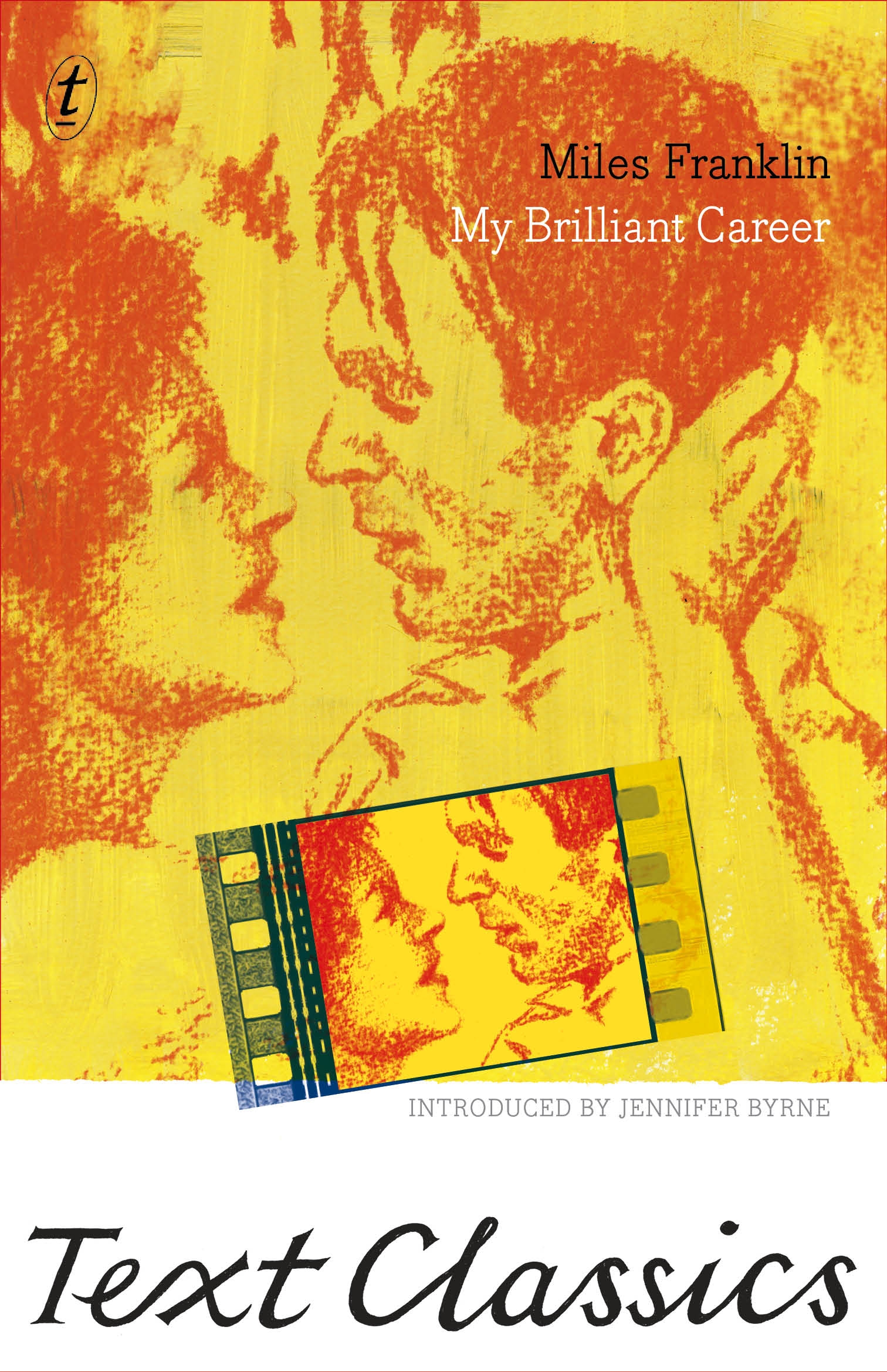
Review: My Brilliant Career

Miles Franklin's My Brilliant Career is a book I was given upon my return from London, encouragement to complete my own novel which I have been working on for far too many years. In many ways it was an appropriate gift: it's written by a young girl, set in an Australian farming community in the Federation years and contains a feisty young woman as the lead character. And while the idea of my novel becoming an Australian classic like Franklin's is an appealing one, at the same time, I'm not sure I want it to be considered too similar in content.

Strange as it may sound, the reason for this is that I actually found Sybylla Melvyn to be a somewhat boring character to behold. Throughout the novel she defines herself as an author though she has yet to publish anything and writing seems to come low down on her list of activities. We are told that her life goal is to be an author and it is upon this that she bases many of her life choices, yet there are very few actions of her making any steps towards achieving this goal. In writing a novel, one of the pieces of advice I was given was to show the characters' actions, beliefs, convictions... not just to tell of them; Actions speak louder than words even if it all relates to fictional characters living in a fictional world. In My Brilliant Career, it is as though instead, Sybylla has little actual drive to be an author, but instead likes to use this fanciful desire of hers as an excuse.

But an excuse from what? By the time we meet her she is living a hard life, her father having lost the comfortable lifestyle into which she was born. She has become forced to toil to earn a living and consequently has come to hate it and her parents for putting her into this position, and yet when she is given an opportunity to escape from it and take up a lifestyle that would give her the time to write and achieve her desire she refuses with the usual pitiful excuse.I don't understand how it is possible for a human being to sail through life completely miserable about their position therein but at the same time making no attempt whatsoever to utilise the power and tools at their disposal to improve upon their lot in life and make it into something better.

Comparing Sybylla's spoken desires with her actions, the author questions whether being a published author is actually the character's life goal, or whether she really is just using it as an excuse. But if it is just an excuse then what is her driving force?  If having a 'brilliant career' as a writer is not her driving force then what is? Sybylla appears to be a driven woman. She gives the perception of having a mind of her own and knowing what she wants. And in this she is strikingly compared with her favourite little sister who during the brief instances of our meetings appears to be the quintessential compliant Edwardian daughter. If this discrepancy between the words and the actions of Sybylla is not just a writing flaw but is an intentional part of the character I find it makes her harder to understand, and far less interesting a character. 

Beware the Ides of March

I've never really been a fan of Caesar, Gaius Julius Caesar.
I took the side of the Greeks at Troy.
I despise his ancestor Venus.
I wished he'd been the one killed by a pile of roof tiles.
I thought the pirates crazy for abducting him in the first place.
I loved Asterix and Obelix for ridiculing him and his army at every turn.

I identified with Gaius Cassius Longinus the brains behind the infamous assassination. 15 March 44 BC. Caesar was 56 and suffered 23 stab wounds, but attained the dignity of dying fully covered.
At a stretch I might identify with Brutus, but what's the point of just being the figurehead to such an epic plot?

And I don't feel I need to justify my position. Caesar was an arrogant sod who thought far too highly of his own self worth. I mean really, who argues for his own ransom to be increased just to increase his own sense of self-worth. He arranged to be elected dictator for life, a less politically restrictive version of the consuls who already governed Rome before proceeding to enhance it further with the trappings of Kings and Emperors.

In my eyes Caesar's assassination was justified, and I'm not just saying it. In Ancient History we studied the man in depth. To the extent that he took on a life of his own. Sitting in class absorbed in the history, one could almost feel his eyes boring into the back of one's head, his breathe on the nape of one's neck. An omnipresence in every lesson, grinning down from a superior height. He was a leader by popular vote, but rallied on by colleagues, I took an active dislike to him.


More recently I encountered him again, a different portrait, but of the same Caesar, and was reminded of my dislike. He was a support act in the life of Cleopatra. The man who won her a kingdom and lost her a library (it is believed that it was Caesar and his men who accidentally if not successfully burned down the library in Alexandria.) The man who wooed himself a woman more powerful than all of Rome and treated her as nothing more than his mistress.

A man who has been given far too much credit simply for standing on the shoulders of others and not acknowledging it. He destroyed one library but was going to create his own, one that belonged to him and Rome, not Egypt. He implemented a new calendar in Rome and history has credited him with it, the Egyptian calendar he encountered when carousing with Cleopatra.

Old Julius had become a familiar enemy. And in that memorable year, when the Ides of March rolled round it felt time to remind him of Suetonius' omen of his impending death.
Whenever the bones of Capys shall be moved it will come to pass that a descendent of his shall be slain at the hands of his kindred and presently avenged at heavy cost to Italy. (Suetonius, Life of Caesar, 81)
Thank you C .

Tuesday, 12 March 2013

Writing Monologues - My Second Attempt


Setting: St Matthew’s Church, Guildford. 1920. The church is filled with mourners (the audience) who sit in silent reverie, for they are participating in the funeral of Mrs Augusta Wentworth. Augusta is also there, but clearly not one of the congregation as she is dressed with her usual flair in a slightly dated gown of a golden yellow, and is wandering around the church. She is aware that it is her own funeral and is providing social commentary as was her habit in life.

Augusta Wentworth is a fictional pioneering member of the Guildford community. She and her husband Thomas arrived in 1860 with their two sons and settled on the upper Swan, north of Guildford which remained their local township. Though she had a rather privileged upbringing in England, like many women in her situation, she experienced hardship in the new Perth colony. As she grew older she became one of the personalities of the area and was renowned for her vibrancy and energy, particularly amongst the younger generations.

Augusta:    You’re late my dear, but that’s alright. They’ve almost finished, so come, sit beside me and rest. We’ll wait until they’ve all gone. It won’t be long now. (She sits listening to the speaker) Ned is such a wonderful speaker, isn’t he? As grandparents we’re not supposed to have favourites, but he was always mine. He’s just like his grandfather; Thomas would have been so proud of him: the way he’s taken up the management of the estate. I suppose we never really expected the orchard to be this successful. 30 years ago it was doing better than I’d ever imagined, but Ned has improved upon that 10 fold. And when he married Miss Eliza it couldn’t have worked out better. They do suit each other so well don’t you think? It’s just a pity it took them so long to discover that for themselves. I remember when Miss Eliza and her sisters first arrived here. Three young ladies all in grey quietly seating in their family pew, each one eyes modestly downcast, but perfectly aware of the attention they were receiving from the congregation: they caused quite a stir, and not just on that first Sunday. Until their arrival there were never enough visual distractions from the monotony of the sermon, particularly in this church. Who would have known they would return to Guildford such beauties.

(She softens as she catches sight of the font.) Miss Kate probably doesn’t remember but she was christened here, in this very font. In fact they all were. (she laughs) John screamed the church down when he was christened. He certainly inherited his father’s lungs. (she pauses to recollect). That wasn’t John. That was Anthony (God bless his soul). The Reverend christened him one week and they buried him the next. He never had a chance at life. His brother married here though: Mr John Wentworth to Miss Katherine Townsend. I remember it well: I had to lend Mrs Townsend my handkerchief as she’d wet her’s through. Such a beautiful wedding; Mrs Townsend made sure of that. The bride, with her golden halo, and strawberries and cream complexion was a vision in white tulle and pink roses. (I do sound like the society pages.) Her sisters less so: delicate pink just doesn’t suit Miss Eliza’s complexion or Miss Mary Anne’s style. 

The second Miss Townsend was never so conventional though: Eliza and Ned bypassed this church for a quieter one down south. A far prettier one too if it’s the one I’m led to believe. Very intimate from what I’ve heard: just what they wanted. It wouldn’t surprise me if they’d planned it all along. They were clever like that. We’re not supposed to know, but so as long as you don’t tell Mrs Townsend… she’d never forgive her daughter if news of the elopement reached her. Not after all of the effort she put into arranging that wedding. You can’t blame them though: two spirited children and a very determined mother of the bride? I probably would have done the same. In fact I know I would have.

I didn’t though. There was never any need to follow anything but my parent’s wish. Thomas and I married in London, nothing elaborate, just white, lace and orange blossoms in the beautiful little church around the corner.  Mother and Father then hosted the wedding feast before Thomas drove me away to our own dear little house. I remember the pattern of the stained glass window dancing on the white silk of my dress before classing horribly with the wallpaper with which the hall was lined. (She looks around before adding sarcastically). No fear of that here. These walls are more appropriate for a hospital than for a church: bright, white, unadorned, and with long thin windows that won’t even open to let in the afternoon breeze. It’s really too puritanical for a C of E church, in my eyes. And I don’t know why I never contributed towards replacing that alter screen… when there were so many opportunities. Perhaps we still can, as a Wentworth family memorial... I’m sure the reverend wouldn’t mind.

At least they were thoughtful enough to decorate it with flowers today. Wattle always was my favourite: the little downy balls of sunshine brightened the hardest of days, then and still now. (Augusta has her back to the reverend so that she can only hear his voice) I gather the Reverend hasn’t changed though. (A dear little man, so kind and well meaning, but heavens he knew how to put his congregation to sleep.) (she turns to face the altar) Good heavens, he has changed.  Poor Canon Everingham must not be with us any longer, he was old even then.

(By now Augusta is at the other end of the church near the door where she can survey the church and the congregation in their entirety.)It really is a drab little church isn’t it. Divine intervention saved us from the previous one and we should have learnt our lesson for this one. I don’t know why I never considered being more vocal when it was being built. Well, I do know really; it was just a matter of managing our own building plans at the time and keeping an eye on two teenage sons. So instead we’re stuck with this: looking at a boring wall whilst listening to a boring sermon; my apologies Reverend. Anything to liven it up! Well, not that! (She’s just caught sight of the World War I memorial.) The Great War! The war to end all wars: the Boer War, the Franco-Prussian War, the Crimean War, the Opium War… I’m just thankful our name is not included. That would have been a tragedy too terrible to bear. We did our part though: here, as far away from the action as possible.  John so desperately wanted to go, but he contributed to the cause in a far better way and without the needless shedding of more blood.  (It was enough that my cousin died in the Crimean.)They weren’t all so fortunate though: poor Miss Mary-Anne. I hope she bounces back as it’s too quiet around here without her laughter. (She pauses)

I remember the summer it was so hot in church that Miss Mary Anne queried wearing her swimming costume to the service. She reasoned that if she was going to dampen so many clothes, it should at least be an outfit that was used to getting wet. It really would have been a sensible idea, if her mother had allowed it. Then again, I’m not entirely sure how the rest of us would have reacted, and the Reverend would have fainted at the sight of her legs swinging in the front row. But of anyone, Mary Anne could have pulled it off. (She pulls out a fan and starts fanning herself) Heavens! I’d forgotten how airless it gets in here. These summer services always were the worst. And yet we never adapted to the climate. A service at sundown would have been far more sensible.

Oh dear, they do drone on, don’t they. I don’t see why, as they all know my life story: I’ve told enough of them. And those I didn’t tell, gossip reached anyhow. It had a way of doing that in this community. I suppose they are family though and I was allowed such outpourings of pride and grief at James’ and his family’s. A mother is not supposed to bury her son! Particularly not when he’s accompanied by his wife and daughter. Such an unexpected tragedy. Poor Lucy. I made sure her flowers were pink. Wreaths of her favourite pink roses. It was the least I could do. They bring back so many memories, even now. Not only of the funeral, but of walking in the gardens cutting flowers for the house with Lucy by my side. She always insisted on carrying the basket no matter that it was far too big and too heavy for her delicate size. I’ve come to hate pink roses, but I couldn’t tell Kate that, and ruin her day.

I was only fortunate that Thomas did not have to experience it with me. His funeral was the first, and that was almost thirty years ago now. It is strange how it still feels as though it were yesterday. The doctor said I was lucky to have had him that long, but that was why we moved to Australia, uprooted a small family and bade farewell to a very happy lifestyle:  so he would live longer. So we could share a full life together. He was only 65. I suppose I just didn’t expect to reach 87. At least, not without him. Truthfully, I’m surprised I lasted this long. This pioneering lifestyle should have exhausted me years ago. Perhaps it was the pioneering spirit that kept me battling on so long. An unwillingness to give up on anything. This is the last one though. I suppose I can relax now.

Friday, 8 March 2013

University Challenge

Sitting at my desk writing a letter to a friend in London I suddenly, and for no apparent reason, missed the UK show University Challenge.

I missed the feel of sitting around the kitchen table, G, C and I, each one straining to hear Jeremy Paxman over the noise of our other housemates cooking dinner or washing up their dishes afterwards. Seated in a row, for that half hour we would put aside our petty bickering, put aside our alleged differences and form our own team competing against the brains of Britain's tertiary institutes; the architect, the electrical engineer and the historian. Each one bringing an entirely unique encyclopaedia of knowledge to the table.

It wasn't an event we engaged in often, just on the off chance when we happened to be in the right place at the right time. But it was a chance to engage in some stimulating mental exercise without the topic being monopolised by one person alone, or hijacked by though completely lacking in any interest at all. It reminded us that we were more than just our job title, and that despite the general monotony of the conversation around we were each one of us full of hidden knowledge based upon hidden interests that general conversations had yet to unveil. And together, a little team of three, each one with our google-esque bank of knowledge we were capable of genius. And we celebrated each other's genius. For once there wasn't a game of one-up-manship, we didn't sneer at the fact another didn't know that standard piece of knowledge.

We really did work as a team, and we really did enjoy that half hour. 

Sunday, 3 March 2013

My inspirational 'list'

Only recently I was asked for a list of people who inspired me, real or imaginary, and importantly, of both genders. A list of names, and why I considered them so important to my identity...

Normally I don't create such lists. I read up on people who interest me and store the relevant novels/biographies in an ever growing personal collection. But I don't see the point in actively remembering a list. It is not the name of the person which is important, but instead the messages they convey through their experiences and how these messages impact upon my life. Rather, the messages get absorbed, the strengths that made them who they are, and the weaknesses that are learned from and applied without the need for personal experiences. The list, who these people are, fades into the background, their importance registered through my continued interest in their lives, the fact their stories never get old. The fact they're people I treasure as my own, as though I have a personal connection with them even though they may have lived and died decades before I was born, or never lived at all.

Recently I discovered a list upon which several of these names resided. A list I too had compiled at some time or other in a bid to suggest reading material to a primary school teacher friend of mine. A list of the 10 Best Literary Heroines for Girls. I grew up with Anne of Green Gables, the March sisters, the Seven Little Australians children of Captain Woolcot, as well as a host of children who didn't appear on that list; Norah and Jim Linton and Wally Meadows of Billabong, Mary Lennox, Little Lord Cedric Fauntleroy. Reading Natasha's list and being reminded of the virtues of these characters, I remember the reasons the stories of each one are still in my bookcase 15 years later. And the reasons I still reread these books every few years.

Later as I got older, as my reading matured, this 'list' of these inspirational people changed, adapted with me. It grew to include real people, past and present. People who were before their time, people who lived unusual lives and were almost forgotten in the annals of history, people who were witty, or just recorded the world around them in their own personal way. People who discovered the beauty of the world and had to share it with the world.
But I will always hold a place in my heart for those early characters, for it was them who encouraged me to dream, to live a full life, to be grateful for what we have as opposed to melancholy about what we don't have or can't have, and to appreciate the beauty of the world around us.

Related Posts Plugin for WordPress, Blogger...