Friday, 21 September 2012

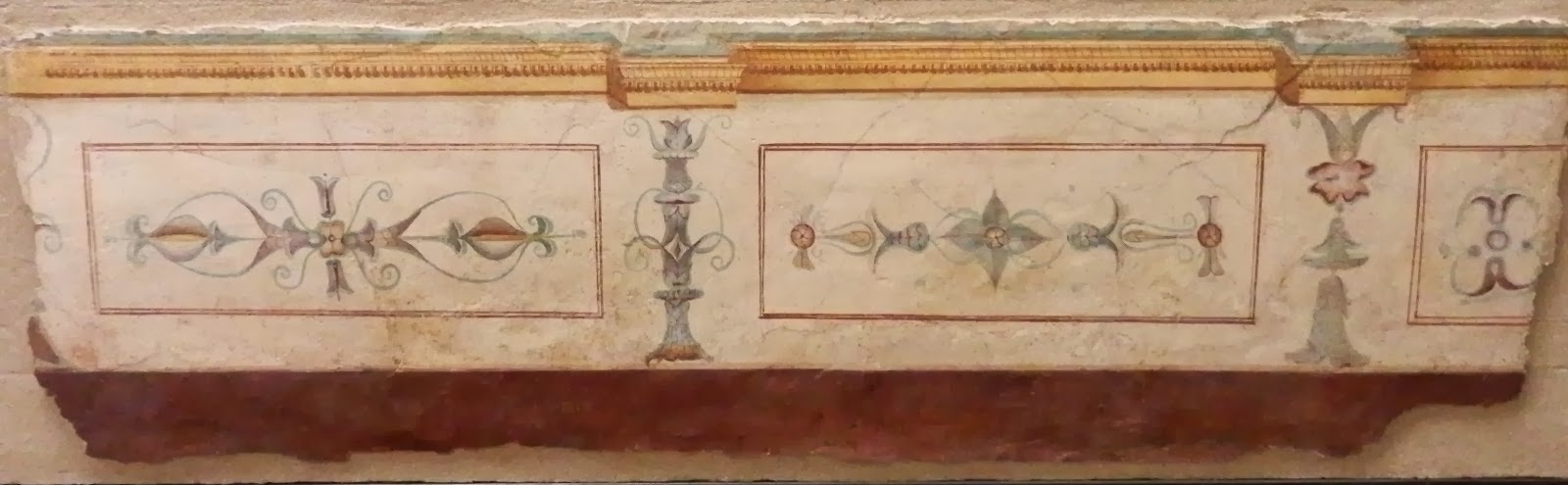
Museo Massimo - Rome

Actually known as Museo Nazionale Romano and located within the Palazzo Massimo, this museum is one of my top recommendations from Rome, and sprang to mind again when my sister requested suggestions for her own imminent visit to this city of old Julius.

As mentioned in a previous post, this museum was a god-send after the disappointment of several others, but raiding my photos I felt the need to showcase a few more of its utter delights.


Though at first glance this appears very much to be a garden room, for the most part, the plants reproduced have an association with funerals and the hope for immortality. Included are Oleander (its toxicity making it a symbol of death), Arbutus (used in funeral rites to protect the dead), Date palm (possessive of powers of regeneration), Box (associated with the god Hades), Coronary Chrysanthemum (a component of funerary garlands) and among others the Opium Poppy (a close relation of death).


I wish I possessed the skills to paint something as detailed as this. It is a familiar scene though, similar to the one I am fortunate to see every time I look out of the family room window onto the back lawn.


The Greek Prometheus who angered the gods by stealing their fire to give to the mortals. As punishment he was chained to a rock and daily, Zeus' eagle would descend upon him and pick out his liver. What impresses me most about this myth though is the medical accuracy of it; even then, the Greeks knew that the liver was the one organ that could regenerate itself, to be eaten again the next day.


My darling friend N is not the most accepting of any ducks due to the indecent behaviour of the ones patrolling UWA, so this is for her, with my love.


While these ducks are beautiful in their detail and realism, they are but a small part of the border of a far more impressive mosaic, portraying most possibly a scene on the river Nile.


Would I be a sadist if I contemplated including a few of these in the tiling of a guest shower? 


Thursday, 6 September 2012

The Orange of Ireland

When I was in Bodrum I bought a very bright orange cotton shawl. While I didn't need it in Greece or Rome, the moment I reached Ireland it became a godsend: after the sun of the Mediterranean the weather in Ireland felt colder than ever and I needed the shawl to keep the icey draughts away from the neck of my coat. Back in Dublin after a tour of the island, I continued to wear it: I liked the colour and against the dull grey sky and cold summer air, it provided a bright spot in each day.


I intended on my last morning in Dublin to visit the Castle and spend the morning meandering through its rooms. So after buying my requisite Ireland charm, I headed in that direction. Unfortunately, as seemed to be my luck with the Dublin Castle, it was closed for the day for a private function. As I approached and bounded into the foyer for more information, a cameraman at the door switched on his camera and very obviously started recording. Thinking about it, I wondered if the function was political: there hadn't been people arriving in cocktail dresses. Was his reaction simply because I was wearing orange? Because I was wearing orange and walking with a purposeful stride, and there had been recent troubles in Belfast? I don't know...

I like to think I looked unique enough to warrant notice.


Wednesday, 5 September 2012

Wishes and Kisses

Ireland appears to be the necessary place to go to have wishes granted. I only managed a week on this emerald isle, but  was offered the most ingenious ways of getting a husband, regaining my virginity and  gaining an even greater gift of the gab.
The first occurred at Glendalough, a small religious community buried in the depth of a lush valley and surrounded by rolling hills, fresh streams cutting their way through the rocky terrain, spontaneous forests of evergreens and a string of lakes that reflected back the pale grey sky.

If anything it was a setting in which to have wishes granted. In the midst of this idyll there was a large stone cross, unadorned with any ornate carving  but standing next to a delicate pink fushia. Now legend as it was told to us is that if you can put your arms around the base of this cross and interlock your fingers you were destined to be married within the year. However as I attempted this feat another person was informed that such a feat simply granted a wish of your choice. I did, and I could, but I wonder if it means I'll get married in a year, have a wish granted or just have long arms. I suppose we shall have to wait...


Further around the coast we encountered Dunuaire Castle situated on a tiny peninsula in the Galway bay. Dating back to the 16th century it is a simple tower castle and courtyard surrounded by high stone wall and thin path circling this outer wall. Here legend has it that a wander anti-clockwise along this beaten path would restore the virginity of anyone who completed the loop. However as wikipedia makes no reference of this but instead tells tale that if a person stands at the front gate and asks a question they will have their answer by the end of the day, I do wonder if our legend find its root in a tour-guide manual. 


And if this isn't enough, our tour then joined the pilgrim to Blarney Castle in the hopes of being blessed with great eloquence or skills of flattery . If only I needed that. However I was as happy as anyone to hang backwards over the battlements of the castle in order to kiss what has become a smooth and polished building block. Such eloquence! The question then becomes: how does it work if you already have a gift of the gab?
do they cancel each other out?
does one negate the other?
are they piled on top of each other so the more you kiss it the more eloquent you become...?


Wednesday, 29 August 2012

Always Look Up.

I appear to have this untoward fascination with Gargoyles. Ask any of my London friends. I utter a cry of delight whenever I see one and, as one my friends roll their eyes and wait patiently for the photo to be taken, as I did 10 - 12 years ago.

My first memory of noticing gargoyles was on a trip to London with my family. I remember standing by the railing peering heavenward as my Father's camera was carefully trained on one of the gargoyles on the roof of the Natural History Museum. I cannot remember what it was, just an animated creature that grinned down at passers-by, always watching, but rarely watched in turn. But I plead that there were and still are so many. Sculptures, figures as gutter pipes, beetles moulded into the walls, silhouettes along the ridge-line standing out along the grey sky.


Since then I've adopted a mantra: 'Always look up', particularly when wandering through and urban jungle. In cities that dwarf us and have done for centuries now, there there are so many amazing details that are usually just above one's eyeline, or miles away hanging precariously off the end of a roof. They date from the middle ages, weathered and worn beyond recognition, to the modern age, art deco carvings presiding over a street off the main thoroughfare of Piccadilly. I've seen comical faces said to belong to the uninviting members of the local council (Aalborg, Denmark), a delicate little owl purported to bring good fortune to whomsoever rubs it (France), mythical creatures, extinct animals, gremlins, and faces frozen in a gamut of emotions.


At London's Natural History Museum, the outside is a myriad of various sculpted animals, arranged into extinct specimens on the left of the main entrance and living species on the right. But what's even more impressive is that the gargoyles continue inside. Monkeys clamber up a vertebrae as you walk beneath them into the main hall, completely ignored by the birds ensconced in the bowery arches. Lemurs gnaw at each other in the corners of the room, while on another pillar a lonesome mouse quietly nibbles away on a purloined berry. Upstairs real skeletons swing along the corridors leading you towards the mineral room where you appear to have sunk to the ocean floor beneath the fish and Crustacea that decorate that stone pillars.

They're all different and they're all beautiful, left to the whim of the sculptor as to what he might chose to draw attention off to the side, away from the general line of vision of passers-by. But when you do catch sight they make you smile, perhaps even laugh at the world around you, or at the absurdity of the sculptor.

However it was in Dublin that I found the most delightful of my collection. Unlike many, these were at eye-level, set back about a metre from the footpath. They decorated the base of a series of columns at the National Library, though I'll admit I'm not sure what a mongoose playing a lute or greyhounds have to do with a library. But then again, they don't need a purpose. I just wonder how many people have walked past them not even noticing the monkeys playing billiards.


The Bodies in the Museum

29 August 2012

Growing up, I remember my school library having this small but informative book on bog bodies. It was hidden amongst a collection of other books of weird historical facts, well away from the history section, in an aisle of the library few people frequented, and I liked it that way.
I got it out repeatedly, for the bog bodies intrigued me. Not so much because they had benefited from a natural form of mummification, but because of what their preserved state could tell us about the lives of them and their communities, and because of the mystery around the ritual behind their deaths.
Preserved bodies can tell us enough about who they were, from the age and gender, determined the bones, to the social status and occupation through the bones and the grave goods. They also answer the 'how' and the 'when' but they fail to address the 'why', and sometimes this is the most intriguing question.

Monday, 27 August 2012

In the shadow of Mt Vesuvius

Being so close, we could not leave Italy without viewing for ourselves the preservation caused by Mt Vesuvius almost two thousand years ago. Allowing two days, we based ourselves in the modern town of Pompeii (anything to avoid Naples) within easy access of the archaeological ruins of Pompeii and Herculaneum.

First stop though, Pompeii
This rambling city was spectacular. The guide books say allow 3 hours, so my fellow enthusiast jokingly said 'for us that means 6 hours' but sensibly we allowed the whole day It was indeed thankful that we had the foresight to consult a medley of guidebooks to determine the buildings least inclined to miss: the ones with the most impressive frescos and mosaics, the ones that played the greatest role in reviving the story of this unfortunate city long after its untimely death. But even with the nine hours we spend we still didn’t manage to see it all.
It was a beautiful place and simply astonishing to think that though nowhere near completely excavated we have been fortunate to learn so much about Roman society due to the catastrophic tragedy of one event, one day 1933 years ago.

Though build along classic Roman lines (a simple grid pattern), Pompeii has experienced millions of feet pacing its cobbled streets, pounding its antique footpaths. Jumping across roads on the raised zebra crossings you could see below you the ragged grooves of the frequent passage of Roman chariots and carts 2000 years ago. Where a history of Roman carts and chariots racing down the streets it can no longer be assumed that either will have retained a smooth flatness we are so used to expecting of our thoroughfares. As one is constantly watching one’s feet, trying to limit the stumbling on these solid if incredibly pitted stone walkways after 9 hours of continual walking one does end up with very sore feet and an aching desire to collapse into the nearest armchair.
Though all features of value rest within a Neapolitan museum the restoration teams have ensured that the uninformed tourist sees such an exact replica that they are never the wiser of this deception played upon them. Gargoyles and appropriately phallic Herm decorate the streets and communal water fountains while on exterior walls Latin graffiti informs you of who to vote for, who is buggering who and rating of the food at various hostelries along the way.
Indoors, mosaics warning ‘Beware the dog’ pave the entrance hall of several houses, goddesses, animals and theatrical masks look down from the walls amongst a myriad of intense colours and beautiful detailing, and taking centre stage gardens and water features fill the square between the ornate columns that continue to hold up the tiled roof.
In one of the back alleys just around the corner from the local pub, sits the brothel, its walls decorated with a ‘how to’ guide appropriate for the trade on which it thrives. Evidence in Pompeii seems to show that in places the exterior walls of the city was plastered over and painted in bright colours, adding a further element of colour and life to an already vibrant image of this deceased city. Just picture the image of the whole city glowing red in the Italian sunlight before in the dying light of the summer sun the crowds dwindle and the ghosts come out to play.
In comparison to Pompeii where you couldn't see from one end of the town to the other and there was a jumble of streets and houses in which to get lost, Herculaneum was tiny. It basically comprised of 6 blocks of buildings and a waterfront now situated 500m from the ocean. But Herculaneum contains artefacts that simply blow the mind. Because this town was engulfed in ash and hot gases that emitted an intense heat, much of the organic material was instantly carbonised before being subsumed in approximately 25 metres of tuff producing an airtight seal that lasted for 1,700 years. It was here that the famous charred loaf of bread was recovered and it is here that one can still see the carbonised roof beams and staircase in situ.
Admittedly the frescos don’t compare with Pompeii, but Herculaneum has a pile of rope and elements of doors, architraves, roof beams that though charred through, have survived well enough to still see the details carved onto these beams. And in one place, there are the first few steps of a wooden staircase leading to an upstairs apartment from the street door; Recognisable stairs that had survived almost 2000 years.
If you've been to Pompeii, don't go for the frescos as you will be disappointed (only one is truly superior), but go for the wood: so much of it still exists, and in an assortment of places that it can’t fail to astonish.

Exploring Ancient Pompeii

Planning to visit Pompeii properly as opposed to making the usual touristy fly in fly out visit, Mum and I decided to station ourselves in the little town of Pompeii instead of the nearby city of Naples. 
Partially it was because we planned to enter as the gates opened and leave with the gates closing being us, so having our bed closer was more sensible. 
Mainly though it was because nothing we have ever heard about Naples was favourable. It was a crime ridden city where two female travellers were not expected to feel safe, and so we didn't even contemplate it as an option (particularly in summer when female attire is smaller than neck to ankle feather coats). 

Unfortunately, our afternoon trip to the city to visit the Archaeological museum ensured the city lived up to this reputation. 

So instead we stayed in a little hotel just off the main square of the little town of Pompeii, and only about 200 metres from the gates of the archaeological site. We entered through the gate near the amphitheatre where not only were there fewer tourists, but we were greeted by the sight of the imposing theatre and sports arena. 


The Amphitheatre

Looking down one of the corridors of the Palaestra.

The building was out of bounds during our visit, but camera lenses can always squeeze through chicken wire to get an unobstructed shot.
Rectangular in shape it has 48 columns down its length and 35 across its width.
The fenced off area in the centre was once a pool.
As sports were closely linked to imperial ideology the building also had some political significance.

A beautifully vibrant house, The House of Venus in the Shell is named from the fresco on the back wall of the peristyle.

Having entered Pompeii at the 'wrong' end, we were fortunate that for the most part there weren't too many other tourists with us, enabling us to get a proper look at the beauty of the buildings.


A street scape (with drinking fountain).
Pompeii was full of drinking fountains, a large number of which were still operational providing the hot and dusty tourists with the necessary hydration.

House of the Four Styles
This name relates to the four styles of painting that exist across Roman buildings, all of which are present in this house. This in itself is not unique though as several Pompeian buildings also possess all four styles.

The Termopolium
This was a fast food outlet/cafe of the time. A marble counter with containers built into the work bench faces directly onto the street. Three kilos of small change was found  in one of the containers, supposedly stashed at the last minute for safekeeping, supporting the idea of this being a public food venue with the money being the day's income.

A yellow panelled wall with a central medallion of Dionysus and Silenus in the House of Maximus,  otherwise known as the House of Venus in a Bikini. 

Programmata on the walls on Abundance St

Including an impressive mosaic of a guard dog in the entrance hall, the House of Paquius Proculus contains beautiful mosaic floors throughout, in addition to a detailed selection of wall paintings.


One of the many proofs that the the Romans were not quite so puritanical as the Victorians would have us believe.


A marble table tripod displayed in the atrium of the House of P. Casca Longus, even though it was discovered in the garden of a neighbouring garden (it was deemed to be too grand for that property and therefore had to have belonged to this one).

House of the Ceii

The House of Menander is perhaps one of the biggest private houses at Pompeii, it's rooms touching all four sides of the block in which it is built. It is also one of the more superbly decorated, with many of the rooms being brightly coloured with fine detailed paintings. This house was named after a painting of the poet on one of the walls.


Built after the Greek model in the second century BC, the Big Theatre was well used enough to be refurbished and enlarged during the Augustan period. This enabled it to seat about 5,000 spectators.

Alongside it is a smaller enclosed theatre (known as the Odeion) probably designated for music and the declamation of verse, and a Quadriporticus. This later building, pictured below, was used as a promenade by theatre goers and by the gladiators who performed in Pompeii.


House of the Diadumeni
From the unusual triple door in the front vestibule, set back and up from the street, you step into a room, decorated on all sides by impressive columns. Though the decorations of the house are reduced to a few flecks of plaster, the impressive dimensions of this atrium provide the feel of a courtyard rather than a simple house hall.

Although we visited this House of the Figured Capitals, it is disappointing to realise that you didn't even see the features that gave the house its name. Existing graffiti supports the idea that the peristyle of this building was being used as a weaver's workshop (officina textrinum) at the time of the explosion. Again, we failed to notice the evidence of this. 

One of the largest and most decorative of the villas currently known within Pompeii, this was named the House of the Faun after the statuette discovered in the Atrium fountain.It is in this house that some of the famous mosaics have been discovered.


Forum Thermal Baths.
The Tepidarium: a room heated to tepid by a bronze brazier. Used as an antechamber for the warm bath of the Calidarium. 


Capitolim


Located past the cemetery, 300 metres outside of the Herculaneum Gate, is this Villa of the Mysteries, intricately decorated in vibrant rich colours.


In the residential part of the house, the majority of the rooms are intricately decorated, however it is one room in particular, lined with a tableau of figures that gives the house its name. Possibly a copy of a Greek painting, it is generally believed to represent a mystery ritual, with an air of mystery to the expressions, look and movement of the various characters. While many are in favour of an Bacchanalian ritual, another interpretation is that of a marriage ritual.


House of the Small Fountain, named from the mosaic decorated fountain located against the back wall.

The Arch of Caligola

After an exhausting day roaming around the hard stone streets of Pompeii, my feet eventually died and we were forced to call it a day (as the town was closing for the night). Unfortunately my camera batteries died first and so I was unable to capture the Forum and temples completely or the infamous brothel.

Next time...


Related Posts Plugin for WordPress, Blogger...